Showing posts with label NATO. Show all posts

Monday, March 27, 2017

How long until Russia responds?

Russian President Putin warned the Russian people about a year ago that the CIA had Russia in their sights for political destabilization. He stated they expected the same tactics as elsewhere. The same tactics the CIA had used in the Arab Spring countries : mass protests, a 'democracy movement' AND LOTS of coverage by western media to make the best of it and apply pressure to the Russian government to comply with the CIAs agenda.

It's not really clear who was behind the opposition rally in Moscow that caused such a ruckus recently. Although I recognize President Putin rules with a heavy hand, and doesn't permit alternate church denominations for example, I have my doubts that the current unrest is a genuinely Russian phenomena.

When things like this happen, the influences behind them may be unclear, but as time progresses, tell tales can give us insight. I'm sure if we keep our eyes open, and don't buy into it or get consumed by the agenda, the underlying forces will become more apparent.

The underlying risk though, is that with THE USA pushing against Russia militarily via NATO, economically via sanctions, the Saudis with oil prices and now the CIA possibly fabricating covert destabilization, Putin may in fact decide its come to the stage Russia must take action.

The action we can expect, if it materializes, is probably military ; both as a clamp down inside Russia's borders to deal with the destabilization, and possibly internationally on the western to southern borders, in retaliation to NATO's surrounding Russia militarily.

Let's keep our heads level and eyes clear as we seek to comprehend what's really going on under the surface. It may not be long before hidden events break loose very much above the surface for all to see.

Wednesday, July 27, 2016

Putin Warns Of War!

What would happen if Russia was successful in shutting down any real news the US Government was trying to share globally? The US would not be heard, and Russia’s point of view would be taken as reality. In actuality, the tables are turned, and Putin has been desperately trying to be heard about avoiding a major war that he believes the USA and NATO are intent on pursuing to gain ultimate geo-political control of much of the world.

This clip was captured at the St Petersburg International Economic Forum, June 2016, and has a retro-view of a speech Putin made in the early 2000s for context and proof at the end. Putin is appealing to the major world media to report not just what the US feeds them, but what Russia is desperately trying to air also, with the aim of avoiding a massive conflict.

We get 99% of our news from media owned by the same people that fund and largely control US Presidential Candidates and much of what goes on in the Council Of Foreign Relations (CFR) and other massively influential bodies in the USA. Money = Power in the USA.

It's important to get multiple points of view to understand what's going on in the world. Years ago, people used to get international papers delivered to them in order to understand multiple points of view and try to understand what's really going on. As things are today, the Russia Today network and Al Jazeera are two major alternative media sources. There is also a massive alternative & citizen media movement with on the ground reporting; for example Steven Ben-Nun captured footage of NATO tanks in Poland a few days ago, and has recently captured huge NATO military convoy moving through Czechoslovakia, where he lives. Steven hosts Israeli News Live, available on YouTube. Along with some other channels like Alex Jones’ Infowars, it provides material that helps supplement the limited view and balance the bias of our incumbent western media.

Back to the clip : I think now and then there's something really wish sharing. This is one of those ‘somethings’. I encourage you to share it with family and friends so they have a more informed view of what may them into a massive war because KNOWLEDGE = POWER. It's when we know what's going on that we can stand and make a difference at a local level that may have a global impact.

https://youtu.be/kqD8lIdIMRo

Sunday, June 26, 2016

Tidings from the East trouble him

It's not often I hear a good, contextual talk about the time of the end. So much information is promoted to scare people, and even to manipulate them, that sounds teachings and exposition doesn't often get a look in. If you listen to this video all the way through, it may change your view of the Time Of The End, make real to you characters depicted in prophesy and give got more certainty and peace fire you and your family with do much happening around us.

https://youtu.be/xO4Yx4bC0n0

Tuesday, February 16, 2016

Merkel NWO puppet pushes no fly zone, ignoring Syrian government

Merkel calls for ‘no-fly zone’ in Syria. Why? To save refugees? What bullshit!

IS is slaughtering people in Syria. Turkey and USA / NATO are supporting and supplying them.

The reason Merkel wants a no fly zone is that Russia has established an air defence shield in aid and at the request of the Syrian government; meaning the NWO can't fly in there, and giving the Syrian government a chance of bringing peace to its country as a sovereign nation.

It's not going well for the NWO. They planned to have Syria fully under their control by now, and don't mind how many people they kill, what they destroy, or what chaos they cause. Owning the western mainstream media means they can life to the sheeple , but thanks to alternative media, including RT, we can see more clearly what's really happening.

What should our response be? I am glad Russia established a shield over Syria. Not because I think Russia are the goods guys (although USA /NATO can make them look like the good guys), but because it brings some stability, peace and leads towards a conclusion of this terrible war.

The bible says to pray for peace, and that the Gospel might go forth. If Russia and Syria stay in the drivers seat, this could be over soon.

1. Maybe we need to ask God to sabotage the snake oil salesmen who masquerade as politicians supposedly trying to get leave talks going when in fact they just want advantage for the NWO in the UN and in the eyes of the world.

2. And also pray that the political wrangling to create a total no fly zone will fall flat. If USA succeeds, it will not bring peace ; it will just help IS by limiting intelligence against IS and by giving IS cover to extract the oil and move it into Turkey where it is sold to support not only IS, but also President Erdogan, who is an Islamic fundamentalist, has declared himself to be God and has nothing but trouble in store for Syria (even threatening the Kurds who have been succeeding against IS).

3. Pray that the efforts of independent media to show the true story in Syria will permeate the minds of the masses and that the court of public opinion will turn against evildoers. Pray that peace will come by exposure of covert deeds that forces USA and cohorts into a corner and makes them drop their guns.

4. Lastly , pray for the people of Syria. If I understand correctly, thousands of coptic Christians have been slaughtered, with a deliberate agenda of killing off Christianity in the country / region. Many people from other faiths have also been killed. The bible does predict that Damascus will be destroyed and made ruins in one day. Damascus is looking pretty devastated right now, but at some stage worse is to come. If it is prophesied, it will come to pass, but please pray for the safety of the Syrian people and that they will beat the Gospel clearly and understand it. They have been through so much. They really need to know Yehovah Rapha, the God who Heals (see https://bible.org/seriespage/60-compound-names-jehovah-jireh-rapha-nissi).

https://www.rt.com/news/332571-merkel-syria-no-fly-zone/

Tuesday, December 22, 2015

USA/NATO & Russia crowding in to Syria as tensions increase

I have mentioned a number of times that USA/NATO are pushing eastward from Europe against Russia. They are also if course changing regimes in the Middle East. There are developments we needed to keep an eye on as regards Syria and Turkey

Syria has long been on the globalist's list of countries for regime change, and USA/NATO a their agent in this respect. Kerri this on mind.

Turkey is in the pocket of the globalists. It is a pawn of USA, a covert dealer and supported of ISIS/IS, including mass shipments of oil from Syria into Turkey; much to the benefit of the Turkish PM and his cronies.

Enter Russia, effectively cleaning up Syria where the USA could not seem to do a thing. Russia is landing 150,000 ground trips in Syria to back Assad and preserve the current government of Syria.

Back lash:
=========
1. Ukraine is hitting Eastern Ukraine's pro-Russian activists hard to do jam up Russian ready Joyce's
2.  I / NATO is making trouble in Crimea, including causing power cuts. Again it, to disrupt and use up resources
3. USA is putting more trips on the ground in Syria when Obama said they definitely would not, promoting a conflict between USA/NATO and the Russian coalition.
4. Turkey is distill Russian shipping through the Bospherus Strait; perhaps the busiest, most congested and most dangerous body of water in the world. If Turkey succeeds in budgeting and delaying Russia, the Russian Navy may have no choice but to push through aggressively.

Up for grabs!
===========
Up for grabs is Syria and then surrounding counties, including Iran. Yes, good ole Uncle Sam is making nice noises to and about Iran now, but don't let that fool you. They want regime change. They want Iran, it's oil and other resources, and its geo-political advantage as their very own.

Russia is not about to allow that to happen, not is Iran . Remember the world's largest oil reserves sit under the Golan Heights. This is legally Syrian territory, but was addressed by Ideal as the spoils of war some years ago. No one talks about this in mainstream media, but it is an absolutely massive prize. And don't be fooled about not needing oil because of green power. Most of our plastics and chemicals come from oil. There's decades of research and development in them, and change would needed to occur gradually. It just can't happen overnight.

On the stage
===========
So, to my understanding, we already have on the world stage in the Middle East:

In the blue team...
USA
Israel
Canada?
Germany
France
UK
Other EU forces?
Turkey

In the red team...
Syria
Russia
China
Iran
India?

Basically there are a stack of polarised forces crowding into the region as the game escalates. If this doesn't wind down soon, were probably looking at a more direct confrontation between the opposing teams with the gloves offer and lying diplomacy giving way to more direct and vindictive rhetoric.

I need to research further who's in there and keep track of what's escalating, but on e thing is clear: it's escalating as I've never seen before, the stakes are genuinely high and the gloves are coming off.

If you are a leading person, now is the time to use your knees.

Lastly, Russia is bitterly opposed to Turkey. There have been many conflicts over the years between Eastern Orthodox Russia and Moslem Turkey. The Russians want Constantinople back. The Russians would like to see Turkey dissolved. Given the sneaky, dishonest role Turkey has played with IS and USA, if things get a bit more tense, we may yet see Russia walk into Turkey.

Wednesday, December 9, 2015

USA playing coy about supporting IS

4 US-led coalition jets seen over Deir ez Zor in Syria day govt troops attacked - Russian MoD https://www.rt.com/news/325179-coalition-jets-syrian-army-attack/

Thursday, July 24, 2014

Putin & Russia: "Time To Do Something"?

I got the below as part of an email from Bill Bonner at The Daily Reckoning. I'm sharing it because he offers a perspective unadulterated by Obama/USA and international cronies (including the media!). The post also alludes to the USA/NATO promising to stay out of Eastern European states which were previously part of the USSR. Read on...

In Defense of Vladimir Putin
By Dan Denning
Dear Diary,

‘Russia is behind it. They were the ones who shot down that plane.’

That was the line given to us by one of our fellow parishioners at the 8 am service, in Maryland, on Sunday.

Oh my...he is losing his mind, we thought. How would he know who shot down a plane over 4,000 miles away? And why would he care?

But in the US media...dinner time chat...and after-church conversations, Russia's president, Vladimir Putin, is condemned. Without trial. Without due process.

The rush to judgment was so fast even the kangaroos hadn't gotten to the courthouse when the verdict was handed down.
Time to ‘do something’


In the lobby of the Hilton Hotel, here in London, we overheard a conversation:

‘What do you think the international community should do,’ asked an earnest voice. The speaker — a middle-aged woman who seemed to care more about her ideas than her appearance — seemed to want to ‘do something’.

Her interlocutor took her simpleminded interrogation and threw it back at her, wrapped in so many good intentions it took her a while to figure out what was in it.

‘We in the international community need to focus attention on these things. We need to develop a dialogue. We need to build faith in our institutions...generate a consensus...work with aid agencies and NGOs...focus on civil society...’blah, blah.

‘Putin can't be allowed to get away with this!’

So universal is the opposition to the Russian president...so fiercely is he set upon by the world improvers...and so many are the fingers that point in his direction, we feel a compulsion to come to his aid.

We are for the underdog...the lost cause...and the die hard — whether he's guilty or not.

Passing over the obvious objection — that it's none of our business — we take up a defence of Russia and of Vladimir Putin. We do so not in pursuit of justice (we've given up on that), but on the trail of mischief and provocation.
A long history of misery


Russia has a long history of misery — most of it self-inflicted.

One of the episodes, not entirely self-inflicted (though greatly self-aggravated), was during the Second World War.

The USSR lost over 20 million people in that ghastly war. It only survived because it was able to pull back across the Steppes...wearing out its enemy in mud, cold and extended lines of communications.

Distance...space...and time are Mother Russia's historic allies. So, it is perfectly understandable for Vladimir Putin to want to at least hold onto eastern Ukraine as a buffer against NATO and the EU.

Meanwhile, despite the assurances given by President H.W. Bush and subsequent US presidents and secretaries of State, the new Russian Federation's periphery states have been drawn toward NATO...the EU...and its potential enemies.

Also, the EU and the US meddled in Ukraine, helping to unseat its democratically elected president, Viktor Yanukovych, so that he might be replaced by someone more agreeable.

Why shouldn't Putin meddle back?

In the second place, what is a passenger jet doing over an active war zone?

Shooting it down was probably an accident. But it is the kind of accident you'd expect.

A bunch of trigger-happy rebels are on the ground shooting at Ukrainian military airplanes. One of them is bound to do something stupid sooner or later. None of the people on the ground had an interest in shooting down the airliner. Except those who wanted to pin it on Putin.

But who knows? Everybody makes mistakes. And if it turns out it was Russian separatists, it is extremely unlikely that they were operating under direct orders from Moscow.

Besides, compared to the reckless and murderous way the US and its allies throw their weight around, Russia has been remarkably restrained and civilised.

Give the guy a break. Whether in jailing people...or killing them...Putin is not the worst.

Regards,

Bill Bonner
For The Daily Reckoning Australia

Friday, August 3, 2012

What on earth is happening with Syria

Syria has warships massing off its coast. China and Russia have sworn to enter into war should western powers attack Syria; and USA/NATO/Israel have been covertly supporting the uprising three (supplying training, arms and covert leadership).

Some months ago, Venezuela was criticised for having warships in the eastern Mediterranean also. The plot thickens. Who knows exactly which powers are there right now! Certainly France, Germany (and NATO in general), USA, Canada, & Turkey in the blue corner; with Russia, China, Iran and perhaps Venezuela (western media doesn't say much about this side) in the red corner. 

Some news articles that substantiate the mass of military hardware meeting in this large pond include:
As you can see, the sources are very varied here.

The questions are:
  1. What on earth is happening with Syria?
  2. Why is all this happening?
  3. What will take place next?
  4. Where will it all lead?
Let's take a look at these, in order. This article addresses point #1, more points coming soon...

1. What on earth is happening with Syria?

I have included two articles from Global Research below to give an overview so you don't have to go to all the above links. These will fill you in a bit on what's going on.

Russian warships enter the Med, bound for Syria

A Russian naval flotilla of warships destined for the Syrian port of Tartus has entered the Mediterranean, Russia's defence ministry said today.
"The Russian ships today passed the Strait of Gibraltar and entered the Mediterranean at 1200 GMT," said a defence ministry spokesman, quoted by Itar-Tass agency.
Led by the Admiral Chabanenko anti-submarine destroyer, the three landing craft left their home port of Severomorsk in the Arctic Circle earlier this month. They are due to be joined in the Mediterranean by the Russian patrol ship Yaroslav Mudry as well as an assistance vessel.
The ships will perform "planned military manoeuvres", said the ministry. Earlier in the month a military source said the ships would be topping up on supplies of fuel, water and foodstuffs.
Russia has denied that the deployment is linked to the escalating conflict in Syria.

source: http://www.timesofmalta.com/articles/view/20120724/world/russian-warships-enter-the-med-bound-for-syria.429985

The US-NATO War on Syria: Western Naval Forces Confront Russia Off the Syrian Coastline?

Global Research, July 26, 2012


"As I went back through the Pentagon in November 2001, one of the senior military staff
officers had time for a chat. Yes, we were still on track for going against Iraq, he said.
But there was more. This was being discussed as part of a five-year campaign plan, he said,
and there were a total of seven countries, beginning with Iraq, then Syria, Lebanon, Libya,
Iran, Somalia, and Sudan."

Former Nato Commander General Wesley Clark.
  
"Let me say to the soldiers and officials still supporting the Syrian regime -- the Syrian
people will remember the choices you make in the coming days...."

Secretary of State Hillary Clinton, Friends of Syria conference in Paris' July 7, 2012

While confrontation between Russia and the West was, until recently, confined to
the polite ambit of international diplomacy, within the confines of the UN Nations
Security Council, an uncertain and perilous situation is now unfolding in the
Eastern Mediterranean.

Allied forces including intelligence operatives and special forces have reinforced
their presence on the ground in Syria following the UN stalemate. Meanwhile,
coinciding with the UN Security Council deadlock, Moscow has dispatched to
the Mediterranean a flotilla of ten Russian warships and escort vessels led by the
Admiral Chabanenko anti-submarine destroyer. Russia's flotilla is currently
stationed off the Southern Syrian coastline.
US Secretary of State Hillary Clinton (L) meets with Russian Foreign Minister Sergey Lavrov in St. Petersburg on June 29, 2012, on the eve of international talks in Geneva to find a political solution to the Syria crisis 
"Polite Diplomacy" (without smiles). Secretary of State Hillary Clinton (L)  and Russia's Foreign Minister
Sergey Lavrov meet in St. Petersbourg, June 29, 2012

Back in August of last year, Russia's Deputy Prime Minister Dmitry Rogozin warned
that "NATO is planning a military campaign against Syria to help overthrow the
regime of President Bashar al-Assad with a long-reaching goal of preparing a beachhead
for an attack on Iran,..."  In relation to the current naval deployment, Russia’s navy chief,
Vice Admiral Viktor Chirkov, confirmed, however, that while the [Russian] flotilla was
carrying marines, the warships would "not be engaged in Syria Tasks".
"The ships will
perform "planned military manoeuvres", said the [Russian Defense] ministry" 
The US-NATO alliance has retorted to Russia's naval initiative, with a much larger naval
deployment, a formidable Western armada, consisting of British, French and American
warships, slated to be deployed later this Summer in the Eastern Mediterranean, leading
to a potential "Cold War style confrontation" between Russian and Western naval forces.
Meanwhile, US-NATO military planners have announced that various "military options"
and "intervention scenarios" are being contemplated in the wake of the Russian-Chinese
veto in the UN Security Council.

The planned naval deployment is coordinated with allied ground operations in support
of the US-NATO sponsored "Free Syrian Army"(FSA). In this regard, US-NATO has speeded
up the recruitment of foreign fighters trained in Turkey, Iraq, Saudi Arabia and Qatar.
Russian warship in the Syrian port of Tartus
Franco-British War Games: "Warship Diplomacy"
France and Britain will be participating later this Summer in war games codenamed
Exercise Cougar 12 [2012]. The games will be conducted in the Eastern Mediterranean
as part of a Franco-British  "Response Force Task Group
" involving  Britain's HMS
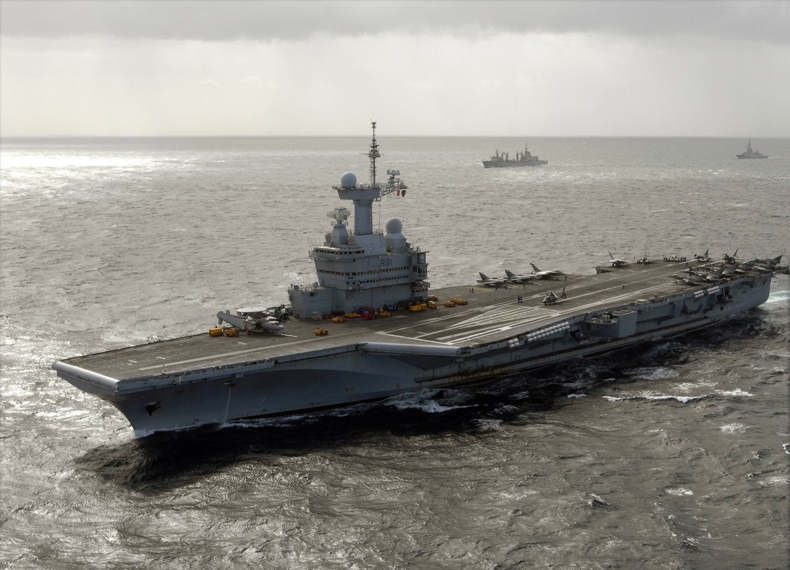
Bulwark and France's Charles De Gaulle carrier battle group. The focus of these naval
exercises will be on amphibious operations involving the (planned simulated) landing
ashore of troops on "enemy territory". 
File:HMS Bulwark midships.jpg
Britain's HMS Bulwark
Fichier:Charles De Gaulle (R91) underway 2009.jpg
France's Charles De Gaulle aircraft carrier
Smokescreen: The Proposed Evacuation of Western Nationals "Using a Humanitarian
Naval Fleet of WMDs"
Barely mentioned by the mainstream media, the warships involved in the Cougar 12
naval exercise will also participate in the planned evacuation of  "British nationals from
the Middle East, should the ongoing conflict in Syria further spill across borders into
neighboring Lebanon and Jordan.":
The British would likely send the HMS Illustrious, a helicopter carrier, along with
the HMS Bulwark, an amphibious ship, as well as an advanced destroyer to provide
defenses for the task force. On board will be several hundred Royal Marine
commandos, as well as a complement of AH-64 attack helicopters (the same ones
used in Libya last year). A fleet of French ships, including the Charles De Gaulle
aircraft carrier, carrying a complement of Rafale fighter aircraft, are expected
to join them.

Those forces are expected stay offshore and could escort specially chartered
civilian ships meant to pick up foreign nationals fleeing Syria and surrounding
countries.  (ibtimes.com, 24 July 2012). 
Sources in the British Ministry of Defense, while confirming the Royal Navy's
"humanitarian mandate" in the planned evacuation program, have categorically
denied "any intention of a combat role for British forces [against Syria]".

The evacuation plan using the most advanced military hardware including the HMS
Bulwark, the Charles de Gaulle aircraft carrier is an obvious smokescreen. The not so
hidden agenda is military threat and intimidation directed against a sovereign nation
located in the historical cradle of civilization in Mespotamia: 
"The Charles De Gaulle alone is a nuclear-powered aircraft carrier with an entire
squadron of jets more advanced than anything the Syrians have -- is sparking
speculation that those forces could become involved in a NATO operation against
Syrian forces loyal to Bashar al-Assad...

The HMS Illustrious, which is currently sitting on the Thames in central London,
will likely only be sent to the region after the end of the Olympics." (Ibid)
This impressive deployment of Franco-British  naval power could also include the USS
John C. Stennis aircraft carrier, which is to be sent back to the Middle East:  
[On July 16, 2912], the Pentagon also confirmed that it would be redeploying the
USS John C. Stennis, a nuclear-powered supercarrier capable of carrying 90
aircraft, to the Middle East... The Stennis would be arriving in the region with an
advanced missile-launching cruiser, .... The carrier USS Eisenhower is already
expected to be in the Middle East by that time (two carriers currently in the region
are to be relieved and sent back to the U.S.).
Amid unpredictable situations in both Syria and Iran, that would have left
U.S. forces stretched and overly burdened if a firm military response were
needed in either circumstance.
(Ibid, emphasis added)

The USS Stennis, at left, and the HMS Illustrious, at right, together in the Persian Gulf in April 1998. The two ships may be sailing together again sooner than expected. Photo: Wikipedia Commons
USS Stennis aircraft carrier
The USS Stennis strike group is to be sent back to the Middle East "by an unspecified
date in the late summer" to be deployed to the Central Command area of responsibility:  
"The Defense Department said that the early deployment had come from a
request made by Marine Corps General James N. Mattis, the commander for
Central Command (the U.S. military authority area that covers the Middle East),
partly out of concern that there would be a short period where only one carrier
would be located in the region." ((Strike group headed to Central Command
early - Stripes Central - Stripes
, July 16, 2012)
Marine Gen. James Mattis, commander of U.S. Central Command, "asked to move up
the strike group’s deployment based on “a range of factors,” and  Defense Secretary
Leon Panetta approved it"... (Ibid)
A Pentagon spokesman stated that the deployment shift of the USS Stennis strike
group pertained to "a wide range of U.S. security interests in the region". "We’re
always mindful of the challenges posed by Iran. Let me be very clear: This is not a
decision that is based solely on the challenges posed by Iran, ... " This is not about
any one particular country or one particular threat.”
intimating that Syria was also
part of planned deployment. (Ibid, emphasis added) 
"Intervention Scenarios" 
This massive deployment of naval power is an act of coercion with a view to terrorizing
the Syrian people. The threat of military intervention purports to destabilize Syria as a
nation state as well as confront and weaken Russia's role in brokering the Syrian crisis.  
The UN diplomatic game is at an impasse. The UN Security Council is defunct. The
transition is towards Twenty-first Century "Warship Diplomacy".  
While an all out allied military operation directed against Syria is not "officially"
contemplated, military planners are currently involved in preparing various
"intervention scenarios": 
‘Western political leaders may have no appetite for deeper intervention. But
as history has shown, we do not always choose which wars to fight - sometimes
wars choose us. ‘Military planners have a responsibility to prepare for
intervention options in Syria for their political masters in case this conflict
chooses them. ‘Preparation will be proceeding today in several Western
capitals and on the ground in Syria and in Turkey
. ‘Up to the point of Assad’s
collapse, we are most likely to see a continuation or intensification of the
under-the-radar options of financial support, arming and advising the rebels,
clandestine operations and perhaps cyber warfare from the West. ‘After any
collapse, however, the military options will be seen in a different light.’
(Daily Mail, July 24, 2012, emphasis added)
Concluding Remarks
The World is at a dangerous crossroads.

The shape of this planned naval deployment in the Eastern Mediterranean with
US-NATO warships contiguous to those of Russia is unprecedented in recent history.  
History tells us that wars are often triggered unexpectedly as a result of "political
mistakes" and human error. The latter are all the more likely within the realm of a
divisive and corrupt political system in the US and Western Europe.
US-NATO military planning is overseen by a centralised military hierarchy. Command
and Control operations are in theory "coordinated" but in practice they are often
marked by human error. Intelligence operatives often function independently and
outside the realm of political accountability.
Military planners are acutely aware of the dangers of escalation. Syria has significant
air defense capabilities as well as ground forces. Syria has been building up its air
defense system with the delivery of Russian Pantsir S1 air-defense missiles.
Any form of US-NATO direct military intervention against Syria would destabilize the
entire region, potentially leading to escalation over a vast geographical area, extending
from the Eastern Mediterranean to the Afghanistan-Pakistan border with Tajikistan
and China.
Military planning involves intricate scenarios and war games by both sides including
military options pertaining to advanced weapons systems. A Third World War scenario
has been contemplated by US-NATO-Israeli military planners since early 2000. 
Escalation is an integral part of the military agenda. War preparations to attack Syria
and Iran have been in "an advanced state of readiness" for several years.
We are dealing with complex political and strategic decision-making involving the
interplay of powerful economic interest groups, the actions of covert intelligence
operatives.
The role of war propaganda is paramount not only in moulding public opinion into
accepting a war agenda, but also in establishing a consensus within the upper echelons
of the decision-making process. A selective form of war propaganda intended for
"Top Officials" (TOPOFF) in government agencies, intelligence, the Military, law
enforcement, etc. is intended to create an unbending consensus in favor of War
and the Police State.
For the war project to go ahead, it is essential that both politicians and military
planners are rightfully committed to leading the war "in the name of justice and
democracy". For this to occur, they must firmly believe in their own propaganda,
namely that war is "an instrument of peace and democracy".
They have no concern for the devastating impacts of advanced weapons systems,
routinely categorized as "collateral damage", let alone the meaning and significance
of pre-emptive warfare, using nuclear weapons.
Wars are invariably decided upon by civilian leaders and interest groups rather
than by the military. War serves dominant economic interests which operate from
behind the scenes, behind closed doors in corporate boardrooms, in the Washington
think tanks, etc.
Realities are turned upside down. War is peace. The Lie becomes the Truth.

War propaganda, namely media lies, constitutes the most powerful instrument of
warfare.
Without media disinformation, the US-NATO led war agenda would collapse like a
deck of cards. The legitimacy of  the war criminals in high office would be broken.
It is therefore essential to disarm not only the mainstream media but also a segment
of the self proclaimed "progressive" alternative media, which has provided legitimacy
to NATO's "Responsibility to protect" (R2P)  mandate, largely with a view to dismantling
the antiwar movement.  
The road to Tehran goes through Damascus. A US-NATO sponsored war on Iran would
involve, as a first step, the destabilization of Syria as a nation state. Military planning
pertaining to Syria is an integral part of the war on Iran agenda. 
A war on Syria could evolve towards a US-NATO military campaign directed against
Iran, in which Turkey and Israel would be directly involved.

It is crucial to spread the word and break the channels of media disinformation.
A critical and unbiased understanding of what is happening in Syria is of crucial
importance in reversing the tide of military escalation towards a broader regional war.
Our objective is ultimately to dismantle the US-NATO-Israeli military arsenal and restore
World Peace.

It is essential that people in the UK, France and the US prevent "the late Summer"
naval WMD deployment to the Eastern Mediterraean from occurring.

It is essential that people in the UK, France and the US prevent "the late Summer"
naval WMD deployment to the Eastern Mediterraean from occurring.

The British
Ministry of Defense has announced that several British warships are required
"to ensure the security" of the Olympic Games. HMS Bulwark is stationed in Weymouth
Bay for the duration of the games. HMS Illustrious is "currently sitting on the Thames in
central London". The deployment of British warships including HMS Bulwark and HMS
Illustrious to the Middle East is envisaged  "after" the Olympic Games.
source: http://globalresearch.ca/index.php?context=va&aid=32079
 

Friday, November 11, 2011

Sole Military Super-Bloc: NATO Issues Daily Reprieves To The World


On October 31 North Atlantic Treaty Organization chief Anders Fogh Rasmussen arrived in the Libyan capital of Tripoli at the end of seven full months of the military bloc’s war in the country and effused: “It’s great to be in Libya, free Libya.”

Like Scipio Africanus the Younger almost twenty-two centuries earlier in what is now Libya’s western neighbor Tunisia, then Carthage, Rasmussen planted the banner of a conquering power on the soil of North Africa. Perhaps NATO will grant Rasmussen, too, the honorific agnomen Africanus after the military bloc’s first war and first conquest on the continent.

While basking in the triumph of what Western commentators have celebrated as NATO’s first complete and uncontested military victory – “the most successful in Nato history” in Rasmussen’s words – in the Libyan capital, the secretary general was questioned by a reporter about plans to replicate the Libyan model in Syria and stated: “My answer is very short. NATO has no intention (to intervene) whatsoever. I can completely rule that out.”

However, to belie his claim he immediately added: “Having said that, I strongly condemn the crackdown on the civilian population in Syria. What has happened in Libya sends a clear signal. You cannot neglect the will of the people.”

The 227-day war against Libya waged first by U.S. Africa Command from March 19-31 and thereafter by NATO is, according to the NATO chieftain, “a clear signal” to Syria, but “NATO has no intention” to commence military actions against Syria. Scant assurance to the nation’s government and populace alike, to be sure.

On the day Muammar Gaddafi was brutally killed, Senator John McCain, ranking member of the Senate Armed Services Committee and presidential candidate in 2008, threatened the president of Syria, the prime minister of Russia and unnamed Chinese leaders with the less than eloquent admonition that they “got a reason to be uneasy” according to one account. He told the BBC on October 20: “I think dictators all over the world, including Bashar al-Assad, maybe even Mr. Putin, maybe some Chinese, maybe all of them, may be a little bit more nervous.” He repeated the parallel between Libya and Syria three days later while in Jordan.

Had Rasmussen been someone other than who he is, which is to say an honest individual, his comments in the Libyan capital would have been limited to the line of Tacitus about a Roman campaign in the century following the Third Punic War: Auferre, trucidare, rapere, falsis nominibus imperium; atque, ubi solitudinem faciunt, pacem appellant. (They plunder, they slaughter, and they steal: this they falsely name Empire, and where they make a wasteland, they call it peace.) Libya has been destroyed. What is left of the city of Sirte presents a vivid image that suits all too well the Roman historian’s words.

Back at home in NATO Headquarters in Brussels three days later, Rasmussen gave his latest monthly press briefing, in which he stated:
“Let me stress that NATO has no intention whatsoever to intervene in Iran, and NATO is not engaged as an alliance in the Iran question.”
He began his comments with this account: “This week I had the privilege to visit Tripoli, the capital of free Libya. It was the first time ever that a NATO Secretary General set foot in the country and something none of us could have imagined only a year ago.”

During the question and answer period which succeeded his presentation he responded to a question on Libya by stating:
“We would be prepared to offer the same kind of assistance as we have offered to other partners within defence and security sector reforms. That is, overall to help put defence and security agencies under civilian and democratic control. We can also help in organizing a modern defence, modern structures. In more specific terms we can help when it comes to institution-building like the building of a defence ministry, how to organize General Staff of the Armed Forces, just to mention some examples.

“NATO has a lot of expertise within defence and security sector reform, and actually a number of our Allies have gone through a similar transition from dictatorship into democracy, so they have a very valuable experience to offer. And I talked with Chairman Jalil and made clear that we are ready to assist Libya within such reform efforts if requested…”
Given the alliance’s history over the past twenty years, what he in fact pledged was that NATO will train – from scratch and in English – the armed forces of the new Libyan proxy regime as it has done previously and is still engaged in doing in other nations and provinces it has invaded and in other manners subjugated: Bosnia, Kosovo, Macedonia, Afghanistan and Iraq.

Libya, which until now has been the only North African nation not to be pulled into NATO’s Mediterranean Dialogue military partnership – Egypt, Tunisia, Morocco and Algeria are members as are Israel, Jordan and Mauritania – will become the eighth member and a joint asset of NATO and U.S. Africa Command.

The chief of what is not only the sole extant military bloc in the world but the largest and longest-lived multinational armed alliance in history may have taken to issuing regular disclaimers concerning attacking new nations well outside the so-called Euro-Atlantic zone, but how much credence the secretary general’s pronouncements should be given is best indicated by how unconscionably NATO lied its way into full-fledged wars in three continents over the past twelve years.

With 28 full members at present, after a 75 per cent increase between 1999-2009, and over 40 partners around the world, the North Atlantic bloc has integrated the militaries of a third of the world’s nations for deployments to war and post-war zones in the Balkans and South Asia, with Africa the next destination.

Its latest trophy is the battered, bloodied and brutalized body of Muammar Gaddafi, murdered after a U.S. Hellfire missile and French laser-guided bombs struck his convoy outside Sirte on October 20, eight months before what would have been his seventieth birthday. So bereft of the most elementary notions of decency and values, moral and aesthetic, are the governments of the West and the people they deserve (as a British writer a century ago reversed the well-known dictum of Joseph de Maistre), that the only stimulants left to awaken their satiated and dehumanized sensibilities are – as they are inured to violence, even on a mass scale – necrophilia and fiendish, ghoulish Grand Guignol. The lower tier of American culture, mass-market escapist entertainment, is consumed by a fascination with vampires, flesh-eating zombies and the like and graphic depictions of foreign leaders and former leaders being mauled and murdered are simply more lurid diversions for jaded ennuyés.

In reference to the murder of Gaddafi and his son Muatassim, the public display of their corpses and the sports enthusiast-like celebration of those gruesome acts by the likes of U.S. Secretary of State Hillary Clinton, Russian representative to NATO Dmitry Rogozin lambasted them as emblematic of sadistic triumphalism, Prime Minister Vladimir Putin denounced them as disgusting and Deputy Speaker of the State Duma Ivan Melnikov characterized the first as “a striking illustration of American and their NATO allies’ policy in the North-African country,” according to Interfax in the third instance.

They are in fact grotesque, in the sense that Hegel defined the word, as the idealization of the ugly.

In his own words, the last-cited Russian official warned: “I think that the entire world should watch today the published photographs and video records of Gaddafi’s murder. It is not just a dead former leader of Libya. It’s the symbol of the sovereignty of an independent country that was torn to pieces by Americans.”

The day after Gaddafi’s murder the same news agency cited another deputy of the lower house of parliament of the same, Communist, party, Vadim Solovyov, as affirming: “The American economy is in need of inexpensive oil, so the U.S. government is even ready to wage wars, if only oil arrives…Any country with large reserves of energy resources – Iran, Syria, Venezuela or Nigeria – could come next.”

NATO ground, air and naval forces continue their murderous rampages in Afghanistan, across the border into Pakistan, in Kosovska Mitrovica, in Libya and off the coast of Somalia in the Gulf of Aden and adjoining waters (where NATO killed the captain of a Taiwanese fishing vessel and wounded two Iranian fishermen in separate attacks earlier this year).

A Stop NATO feature in August provided an, admittedly incomplete, list of nations that NATO, actuated by its first Strategic Concept for the 21st century adopted at the bloc’s summit in Lisbon last November and its initial implementation in Libya this year, could attack or otherwise intervene in next: Algeria, Belarus, Bolivia, Central African Republic, Chad, Cuba, Democratic Republic of Congo, Cyprus, Ecuador, Eritrea, Iran, Lebanon, Madagascar, Mali, Moldova-Transdniester, Myanmar, Nicaragua, Niger, Nigeria, North Korea, Pakistan, Palestine, Somalia, the South Caucasus (Abkhazia, Nagorno-Karabakh, South Ossetia), Sudan-South Sudan, Suriname, Syria, Uganda, Venezuela, Western Sahara, Yemen and Zimbabwe.

In the interim the Obama administration announced the deployment of special forces to four of the above nations and on the day of Gaddafi’s murder the chairman of the Senate Foreign Relations Committee’s subcommittee on African affairs, Senator Chris Coons, was reported by Associated Press as asserting that “Moammar Gadhafi’s death and the promise of a new Libyan regime are arguments for the measured U.S. military response in central Africa where the U.S. has sent roughly 100 troops” to Uganda, Congo, the Central African Republic and South Sudan.

That the nations of the world require almost daily assurances, however untrustworthy, that they will not be attacked by the mightiest multinational military formation in history is an indictment of the age that submits to living under such ongoing and ubiquitous threats. The time is ripe and in fact long overdue for issuing a call for an international anti-NATO initiative addressed to individuals, organizations, political parties and governments to convene an extraordinary session of the United Nations General Assembly to demand the disbanding of the North Atlantic Treaty Organization as a – as the gravest – threat to world peace.

Rick Rozoff is a frequent contributor to Global Research.


source: http://www.globalresearch.ca/index.php?context=va&aid=27482

Tuesday, September 20, 2011

The Encirclement of Russia: U.S.-NATO Interceptor Missile Anaconda Loop Around Russia

I have been saying for some time now that countries formerly not solidly aligned with the USA or Russian after the iron curtain collapsed would be pushed into one of these major camps as time passed. Russia has been trying to regain its might by forming alliances and moving west. NATO and USA have been pushing east. What I did not see clearly however is that USA has been encircling Russia with a missile defense barrier. Don't believe this is just about defense, these missiles and facilities will have the capacity to be used for 'first strike' also. Read on, and marvel at how far the USA has progressed with this.

Steve B
======

-"Their task is to neutralize our nuclear weapons and push us out of the major areas of the world's oceans. In this case - even from the Black Sea.
Turkey, of course, has its own views on the missile defense system, but Romania is a pawn in the hands of the U.S., and its elite exist only because of American support. The same can be said about Poland. As a result, there is a chain of U.S. missile defense sites along the Russian border, stretching from Turkey through Romania and Poland to Norway."

The U.S. and Romania signed an agreement on deployment of the elements of a U.S. missile defense system. Earlier it was reported that some elements of the EUROPRO system will appear in Turkey. Everything indicates that the U.S. military machine and NATO are inexorably approaching the Russian borders.


The US-Romanian agreement was signed on September 13 during a visit to Washington of Romanian President Traian Basescu. The document was signed by the foreign ministers of the two countries - Hillary Clinton and Theodore Baconschi. Later Barack Obama met with the participants of the talks, although initially he was not planning to meet with Basescu.

According to the document, by 2015 elements of a U.S. ground-based missile defense system will appear at the former Romanian Air Force Base in Deveselu. They will include a radar (SAR) complex Aegis, an operational control center, and mobile missile batteries with Standard Missile-3 (SM-3) interceptor missiles. Approximately 200 U.S. military personnel will reside at the base, but if necessary this number will be increased to 500.

Nothing was said with regard to the fact of who the missile base will be directed against. Earlier, U.S. officials and Basescu had repeatedly reiterated that the missile defense is not directed against Russia. However, recently there was another event that made the Russian side doubt that statement.


Some time ago the United States and Turkey announced that Turkish territory would host an early warning radar system, EUROPRO. Spokesman of the Turkish Foreign Ministry Selcuk Unal said that the decision to implement a projected system of protection against missile attacks by the U.S. and NATO was adopted at the Lisbon summit in 2010. Turkey has actively contributed to these original plans and made a significant contribution to the work. He added that there have been negotiations on the extent of Turkey's participation in this system, which have finally entered into the final stage.

According to the Turkish diplomat, the radar will be located in the southeastern part of the country. This will allow "scanning" the area with a radius of several thousand kilometers. Turkey insists that the new object is not directed against anyone, especially against Russia. This will only allow the country to contribute to the development of a new security system of NATO.


According to the American plans, Turkey will first host a mobile radar detection system AN/TPY-2. By 2015 there will be a new sea-and land-based modification of the SM-3. Subsequently, the system will be improved further so that it successfully reflects the threat against the United States and Europe from missiles of medium and long range.

The appearance of the two similar objects in the immediate proximity of Russian borders could not but worry the leadership of the country. In his statement, the Russian Foreign Ministry stressed the need to sign a special agreement clearly stipulating that the elements of a U.S. missile defense are not directed against Russia. "The developments only increase the urgency of the need to obtain solid, legally binding assurances from the U.S. and NATO that missile defense facilities being deployed in Europe are not directed against Russia's strategic nuclear forces," commented MFA.


"The agreement with Romania to deploy a ground-based version of SM-3 missile system and Aegis at the former air base at Deveselu, as well as the recent announcement of the impending deployment of the U.S. forward based anti-missile radar AN/TPY-2 in Turkey, suggests that the implementation of U.S. and European missile plans is quick and smooth. This is happening amid a lack of progress in the NATO-Russian and Russian-American dialogue on the subject of missile defense," the Ministry commented.

"Scheduled for deployment in Romania by 2015, regardless of the evolution of real missile challenges,a  missile defense base is another link in the strategic infrastructure of the global missile defense system developed by the U.S. The NATO-Russia Council needs to develop effective and targeted decisions about the purpose and architecture of the missile defense in the region", stressed the Russian Foreign Ministry.


It may be added that the objects in Romania and Turkey are not the only ones of this kind. The United States and Poland agreed to deploy Patriot interceptor missiles at a Polish base in the town of Morag. The distance from this object to Kaliningrad is no more than 100 kilometers. As in the case of Romania, the Polish authorities also have repeatedly stated that Russian missile defense is not threatened. Initially it was planned to place these missiles near Warsaw, but they were eventually "pushed" to the Russian border. 
Finally, further north there is an American radar in Norway, in the town of Varde, located near the Russian border.

Although officially its function is to monitor space debris, the Russian military and diplomats suspect that it was placed in violation of the ABM Treaty of 1972. Russia conducts regular talks on the operation of this facility with both the U.S. and Norway.

What does the emergence of a chain of objects of a U.S. missile defense system at the Russian borders mean? Military expert and senior vice president of the Academy of Geopolitical Issues Konstantin Sivkov spoke on this subject in an interview with Pravda.ru:
 "The U.S. and NATO continue the policy of encirclement of Russia with their bases in the framework of the project 'Anaconda loop.' Our country is still perceived by the Americans as the main strategic adversary, and they do not even make any secret of it. 

"Their task is to neutralize our nuclear weapons and push us out of the major areas of the world's oceans. In this case - even from the Black Sea.
Turkey, of course, has its own views on the missile defense system, but Romania is a pawn in the hands of the U.S., and its elite exist only because of American support. The same can be said about Poland. As a result, there is a chain of U.S. missile defense sites along the Russian border, stretching from Turkey through Romania and Poland to Norway."


source: http://globalresearch.ca/index.php?context=va&aid=26595

Thursday, September 15, 2011

The Devil Writes a Handbook: "The Responsibility to Protect" (2002)


Editors' introduction: The "Responsibility to Protect" (R2P) doctrine is a diabolical bit of psychological wizardry; a conceptual Trojan Horse designed to advance the cause of global governance on a moral platform.  The purpose of the doctrine is to legitimize and make legal wars of aggression against non-threatening nation-states.  Strumming on emotional chords, a new music has been composed, helping power-hungry aggressors to gain entry into territories of otherwise reluctant sovereign states.  Although every war in history has been accompanied by a multifaceted sales pitch--utilizing either fear, greed, ideology or religion; even appeals for a better world--the R2P war is now waged with the exclusive appeal to "help" the helpless; to "save" people's lives.  It is a media war; a war for the hearts and minds.  

If only these altruistic appeals could be considered trustworthy; if only the claims of 'genocide' could be verified.  They are not.  That the establishment media maintains for the public a near-total blackout pertaining to matters of substance, a platform is laid for these wars to continue.  New legal norms are now being established without adequate knowledge, public participation or debate.  The situation is so bizarre, in fact, that those opposing the current Libyan aggression have frequently and irresponsibly been painted as advocates of dictators or tyrants.  This is modern democracy at its finest.  Orwell himself wasn't so bold a visionary.

One notable aspect of the following article (transcribed from a 2002 issue of the Council on Foreign Relations' bi-monthy magazine,Foreign Affairs) is that it draws immediate attention to the amount of time that has been spent--largely in darkness--bringing this obscure globalist concept to fruition.  Only this year, in 2011, did the world witness its first UN-sponsored R2P war (and many have yet to notice it still).  In the article below, however, we see outlines of a 'Libyan operation' years in advance.  In the article below we read of a blueprint that conveniently allows for a rush to judgment; one that's loaded with feigned compassion; that's full of gaping legal loopholes; and that prefers exclusivity of those empowered to decide and enforce its dictates. Especially we feel the outright hypocrisy of those individuals and governments that claim to advance freedom and democracy while bombing cities and murdering innocent men, women, and children.  

This was written nine years ago, and the R2P trail goes back even further still.  Who among us was aware?  Who among us was asked what we thought?  Whatever the case--regardless of our ignorance yesterday or today--regardless of our feelings of powerlessness or apathy--we are here, this is our lot, and we must make an effort to deal with it.  The Libyan operation is the first R2P operation, but unless we take action, unless we educate ourselves and others, it won't be the last.  Already Syria is on the horizon; already Sudan looms largely; already Belarus beckons.  We see the signs.  We discern the true intent.  And soon it will be our own sovereignty that sits in the cross hairs.  We here write from the United States.  We ask rhetorically, has not our Constitution already been stretched to the breaking point by these same people?  We are not alone.  For these are not "mere words on paper"--there are real consequences, real harm to real people.  

And although we may not understand the problem, we already know the remedy.  The battle is waged first in the mind.  These things can only come about when there is a psychological smokescreen to blind the world.


The Responsibility to Protect
By Gareth Evans and Mohamed Sahnoun
Originally published in Foreign Affairs
November/December 2002, Volume 81, Number 6
Images and captions added by Color Revolutions and Geopolitics


Revisiting Humanitarian Intervention


The international community in the last decade repeatedly made a mess of handling the many demands that were made for "humanitarian intervention": coercive action against a state to protect people within its borders from suffering grave harm.  There were no agreed rules for handling cases such as Somalia, Bosnia, Rwanda, and Kosovo at the start of the 1990s, and there remain none today.  Disagreement continues about whether there is a right of intervention, how and when it should be exercised, and under whose authority.

Gareth Evans
Since September 11, 2001, policy attention has been captured by a different set of problems: the response to global terrorism and the case for "hot preemption" against countries believed to be irresponsibly acquiring weapons of mass destruction.  These issues, however, are conceptually and practically distinct.  There are indeed common questions, especially concerning the precautionary principles that should apply to any military action anywhere.  But what is involved in the debates about intervention in Afghanistan, Iraq, and elsewhere is the scope and the limits of countries' rights to act in self-defense --not their right, or obligation, to intervene elsewhere to protect peoples other than their own.

Mohamed Sahnoun
Meanwhile, the debate about intervention for human protection purposes has not gone away.  And it will not go away so long as human nature remains as fallible as it is and internal conflict and state failures stay as prevalent as they are.  The debate was certainly a lively one throughout the 1990s.  Controversy may have been muted in the case of the interventions, by varying casts of actors, in Liberia in 1990, northern Iraq in 1991, Haiti in 1994, Sierra Leone in 1997, and (not strictly coercively) East Timor in 1999.  But in Somalia in 1993, Rwanda in 1994, and Bosnia in 1995, the UN action taken (if taken at all) was widely perceived as too little too late, misconceived, poorly resourced, poorly executed, or all of the above.  During NATO's 1999 intervention in Kosovo, Security Council members were sharply divided; the legal justification for action without UN authority was asserted but largely unargued; and great misgivings surrounded the means by which the allies waged war.

It is only a matter of time before reports emerge again from somewhere of massacres, mass starvation, rape, and ethnic cleansing.  And then the question will arise again in the Security Council,  in political capitals, and in the media: What do we do?  This time around the international community must have the answers.1  Few things have done more harm to its shared ideal that people are all equal in worth and dignity than the inability of the community of states to prevent these horrors.  In this new century, there must be no more Rwandas.

Secretary-General Kofi Annan, deeply troubled by the inconsistency of the international response, has repeatedly challenged the General Assembly to find a way through these dilemmas.  But in the debates that followed his calls, he was rewarded for the most part by cantankerous exchanges in which fervent supporters of intervention on human rights grounds, opposed by anxious defenders of state sovereignty, dug themselves deeper and deeper into opposing trenches.

If the international community is to respond to this challenge, the whole debate must be turned on its head.  The issue must be reframed not as an argument about the "right to intervene" but about the "responsibility to protect."  And it has to be accepted that although this responsibility is owed by all sovereign states to their own citizens in the first instance, it must be picked up by the international community if that first-tier responsibility is abdicated, or if it cannot be exercised.

Sovereignty As Responsibility

Let us pause while our learned authors get ready for the costume ball.  The idea here is to parade around highly-dubious acts of imperial aggression in "humanitarian" disguises.  Below is proof of these authors' manipulative intent--a rare case, indeed, of the logic of a psychological operation having intentionally been made public.     
Using this alternative language will help shake up the policy debate, getting governments in particular to think afresh about what the real issues are.  Changing the terminology from "intervention" to "protection" gets away from the language of "humanitarian intervention."  The latter term has always deeply concerned humanitarian relief organizations, which have hated the association of "humanitarian" with military activity.  Beyond that, talking about the "responsibility to protect" rather than the "right to intervene" has three other big advantages.  First, it implies evaluating the issues from the point of view of those needing support, rather than those who may be considering intervention.  The searchlight is back where it should always be: on the duty to protect communities from mass killing, women from systematic rape, and children from starvation.  Second, this formulation implies that the primary responsibility rests with the state concerned.  Only if that state is unable or unwilling to fulfill  its responsibility to protect, or is itself the perpetrator, should the international community take the responsibility to act in its place.  Third, the "responsibility to protect" is an umbrella concept, embracing not just the "responsibility to react" but the "responsibility to prevent" and the "responsibility to rebuild" as well.  Both of these dimensions have been much neglected in the traditional humanitarian-intervention debate.  Bringing them back to center stage should help make the concept of reaction itself more palatable.

At the heart of this conceptual approach is a shift in thinking about the essence of sovereignty, from control to responsibility.  In the classic Westphalian system of international relations, the defining characteristic of sovereignty has always been the state's capacity to make authoritative decisions regarding the people and resources within its territory.  The principal of sovereign equality of states is enshrined in Article 2, Section 1, of the UN Charter, and the corresponding norm of nonintervention is enshrined in Article 2, Section 7: a sovereign state is empowered by international law to exercise exclusive and total jurisdiction within its territorial borders, and other states have the corresponding duty not to intervene in its internal affairs.  But working against this standard has been the increasing impact in recent decades of human rights norms, bringing a shift from a culture of sovereign impunity to one of national and international accountability.  The increasing influence of the concept of human security has also played a role: what matters is not just state security but the protection of individuals against threats to life, livelihood, or dignity that can come from from within or without.  In short, a large and growing gap has been developing between international behavior as articulated in the state-centered UN Charter, which was signed in 1946, and evolving state practice since then, which now emphasizes the limits of sovereignty.

June 26, 1945: Edward Reilly Stettinius, Jr., Secretary of State, Chairman of the delegation from the United States, signing the UN Charter at a ceremony held at the Veterans' War Memorial Building in San Francisco.
Crest of the Fabian Society
Indeed, even the strongest supporters of state sovereignty will admit today that no state holds unlimited power to do what it wants to its own people.  It is now commonly acknowledged that sovereignty implies a duel responsibility: externally, to respect the sovereignty of other states, and internally, to respect the dignity and basic rights of all the people within the state.  In international human rights covenants, in UN practice, and in state practice itself, sovereignty is now understood as embracing this duel responsibility.  Sovereignty as responsibility has become the minimum content of good international citizenship.  Although this new principal cannot be said to be customary international law yet, it is sufficiently accepted in practice to be regarded as a de facto emerging norm: the responsibility to protect.

Above is the stained glass window from the Beatrice Webb House, Surrey, England, former headquarters of the Fabian Society.  This organization was at the ideological center of the early moves toward economic and political globalization, providing 'humanitarian' cover to assist in the creation of international governing bodies, like the League of Nations and its more expansive successor, the United Nations.  At center right in the image, George Bernard Shaw and Sydney Webb smash at the world with hammers.  Just above the world is the same crest shown separately above: a wolf in sheep's clothing.  And across the top we read an excerpt from a poem.  The verse is from The Rubaiyat of Omar Khayyam, and reads: "Ah, Love! could you and I with Him conspire/ To grasp this sorry Scheme of Things entire,/ Would not we shatter it to bits--and then/ Re-mould it nearer to the Heart's Desire!"  
Military Intervention: Setting the Bar

Gaddafi waits to see if he qualifies for R2P intervention.
The responsibility to protect implies a duty to react to situations in which there is compelling need for human protection.  If preventative measures fail to resolve or contain such a situation, and when the state in question is unable or unwilling to step in, then intervention by other states may be required.  Coercive measures then may include political, economic, or judicial steps.  In extreme cases--but only extreme cases--they may also include military action.  But what is an extreme case?  Where should we draw the line in determining when military intervention is defensible?  What other conditions or restraints, if any, should apply in determining whether and how that intervention should proceed?  And, most difficult of all, who should have the ultimate authority to determine whether an intrusion into a sovereign state, involving the use of deadly force on a potentially massive scale, should actually go ahead?  These questions have generated an enormous literature and much competing terminology, but on the core issues there is great deal of common ground, most of it derived from "just war" theory.  To justify military intervention, six principles have to be satisfied: the "just cause" threshold, four precautionary principles, and the requirement of "right authority."

Operation Just Cause

Q: What do you see?  A: All I see is R2P.
As for the "just cause" threshold, our starting point is that military intervention for human protection purposes is an extraordinary measure. For it to be warranted, civilians must be faced with the threat of serious and irreparable harm in one of just two exceptional ways.  The first is large-scale loss of life, actual oranticipated, with genocidal intent or not,which is the product of deliberate state of action, state neglect, inability to act, or state failure.  The second is large-scale "ethnic cleansing,"actual or anticipated, whether carried out by killing, forced expulsion, acts of terror, or rape.   

Why does the bar for just cause need to be set so high?  There is the conceptual reason that military intervention must be very exceptional.  There is also a practical political rationale: if intervention is to happen when it is most necessary, it cannot be called on too often.  In the two situations identified as legitimate triggers, we do not quantify what is "large scale" but make clear our belief that military action can be legitimate as an anticipatory measure in response to clear evidence of likely large-scale killing or ethnic cleansing.  Without this possibility, the international community would be placed in the morally untenable position of being required to wait until genocide begins before being able to take action to stop it.  The threshold criteria articulated here not only cover the deliberate preparation of horrors such as in the cases of Bosnia, Rwanda, and Kosovo.  They can also apply to situations of state collapse and the resultant exposure of the population to mass starvation or civil war, as in Somalia.  Also potentially covered would be overwhelming natural or environmental catastrophes, in which the state concerned is either unwilling or unable to help and significant loss of life is occurring or threatened.  What are not covered by our "just cause" threshold criteria are human rights violations falling short of outright killing or ethnic cleansing (such as systematic racial discrimination or political oppression), the overthrow of democratically elected governments, and the rescue by a state of its own nationals or foreign territory.  Although deserving of external action--including in appropriate cases political, economic, or military sanctions--these are not instances that would seem to justify military action for human protection purposes.

Precautionary Principles

Of the precautionary principles needed to justify intervention, the first is "right intention."  The primary purpose of the intervention,whatever other motives intervening states may have, must be to halt or avert human suffering.  There are a number of ways of helping ensure that the criterion is satisfied.  One is to have military intervention always take place on a collective or multilateral basis.  Another is to look at the extant to which the intervention is actually supported by the people for whose benefit the intervention is intended.  Yet another is to look to what extant the opinion of other countries in the region has been taken into account and is supportive.  Complete disinterestedness may be an ideal, but it is not likely always to be a reality: mixed motives, in international relations as everywhere else, are a fact of life.  Moreover, the budgetary cost and risk to personnel involved in any military action may make it imperative for the intervening state to be able to claim some degree of self-interest in the intervention, however altruistic its primary motive.

"Another [criterion for military intervention] is to look at the extent to which the intervention is actually supported by the people for whose benefit the intervention is intended."  What are these writers telling us?  Isn't the object of R2P to save "the people" from a 'massacre'?  Who wouldn't want to be saved from a massacre?  Odd behavior indeed.  It makes one wonder who "the people for whose benefit the intervention is intended" really are.  Take a look at the image above: a massive pro-Gaddafi rally in the capital of Tripoli, July, 2011.  Not only are these people "not supportive" of being saved...these are "the people" being killed by NATO bombs.  Take a look at the video below and think about the gap between truth and fiction concerning R2P.  How are we to interpret this: tough love??  Perhaps "the people" of Libya are not those that the R2P intervention will benefit.  
How Western media reports the Libyan bombing
The second precautionary principle is "last resort": military intervention can be justified only when every nonmilitary option for the prevention or peaceful resolution of the crisis has been explored, with reasonable grounds for believing lesser measures would not have succeeded.  The responsibility to react with military coercion can be justified only when the responsibility to prevent has been fully discharged.  This guideline does not necessarily mean that every such option must literally have been tried and failed; often there is simply not enough time for that process to work itself out. But it does mean that there must be reasonable grounds for believing that, given the circumstances, other measures would not have succeeded.    

The video above captures just one brief moment in the entire NATO-sponsored Libyan campaign, one the mainstream media just won't share.  This is Tripoli, the capital of Libya, a modern coastal city of over two million people.  In the language of R2P, the men with guns must necessarily be the "humanitarian" protectors of the Libyan population, seeing as how their cause has been taken up and sponsored by the United Nations.  Underneath the salesmanship, however, a different picture emerges...  

The third principle is "proportional means": the scale, duration, and intensity of the planned military intervention should be the minimum necessary to secure the defined objective of protecting people.  The scale of action taken must be commensurate with its stated purpose and with the magnitude of the original provocation.  The effect on the political system of the country targeted should be limited to what is strictly necessary to accomplish the intervention's purpose.  Although the precise practical implications of these strictures are always open to argument, the principles involved are clear enough.

Abdel Hakim al-Hasadi, the NATO operation's new military governor in Tripoli, Libya, is certainly no R2P angel, regardless of what the Western media now wants you to believe.  In a recent interview, Dr. Webster Tarpley said this about al-Hasadi "He is a person who was a close friend of Bin Laden, trained with Bin Laden in Afghanistan at those camps. He organized Jihadists to go into Iraq and Afghanistan to kill US soldiers. He presumably has killed US soldiers himself...He is now directing a reign of terror [in Tripoli]...His signature is mass murder. He has left a trail of bodies across the globe. Right now you can even see on Aljazeera that they are singling out Black Libyans or indeed anybody Black. You can be from Fazan in Libya or you can be a guest worker from Mali or Chad or some other African countries and you are going to be prosecuted and hounded and maybe lynched and executed by these NATO puppet rebel forces...the current military governor needs to be arrested and put on trial for genocide" 
Finally, there is the principle of "reasonable prospects": there must be a reasonable chance of success in halting or averting the suffering that has justified the intervention; the consequences of action should not be worse than the consequences of inaction.  Military action must not risk triggering a greater conflagration.  Applying this precautionary principle would, on purely utilitarian grounds, likely preclude military action against any one of the five permanent members of the Security Council, even with all other conditions for intervention having been met.  Otherwise, it is difficult to imagine a major conflict being avoided or success in the original objective being achieved.  The same is true for other major powers that are not permanent members of the Security Council.  This raises the familiar question of double standards, to which there is only one answer: The reality that interventions may not be plausibly mounted in every justifiable case is no reason for them not be mounted in any case.

Whose Authority?

R2P implies global governance: thus spoke the editors of this website.
The most difficult and controversial principle to apply is that of "right authority."  When it comes to authorizing military intervention for human protection purposes, the argument is compelling that the United Nations, and in particular its Security Council, should be the first port of call.  The difficult question--starkly raised by the Kosovo war--is whether it should be the last.

UN headquarters, New York City
The issue of principle here is unarguable.  The UN is unquestionably the principle institution for building, consolidating, and using the authority of the international community.  It was set up to be the linchpin of order and stability, the framework within which members of the international system negotiate agreements on the rules of behavior and the legal norms of proper conduct to preserve the society of states.  The authority of the UN is underpinned not by coercive power but by its role as the applicator of legitimacy.  The concept of legitimacy acts as the connecting link between the exercise of authority and the recourse to power.  Attempts to enforce authority can be made only by the legitimate agents of that authority.  Nations regard collective intervention blessed by the UN as legitimate because a representative international body duly authorized it, whereas unilateral intervention is seen as illegitimate because it is self-interested.  Those who challenge or evade the authority of the UN run the risk of eroding its authority in general and undermining the principle of a world order based on international law and universal norms.

UN Security Council: this small room is the place where the fate of whole nations is now decided.  It is here as well that the authors of this article advocate granting primary authority towards the violation of national sovereignty.  Ironically, this unelected, authoritarian body claims to work in the service of 'democracy'.  Actually this is no irony at all--it is deception--reality in this case being shielded by a clever use of language.  So it is, as well, with R2P.  The responsibility to "protect" is, in reality, only the responsibility to "power."  Power is the essence of R2P. 
The task is not to find alternatives to the Security Council as a source of authority, but to make the council work better than it has.  Security Council authorization should, in all cases, be sought prior to any military intervention being carried out.  Those advocates calling for an intervention should formally request such authorization, ask the council to raise the matter on its own initiative, or demand that the secretary-general raise it under Article 99 of the UN Charter.  The Security Council should deal promptly with any request for authority to intervene where there are allegations of large-scale loss of life or ethnic cleansing.  It should, in this context, also seek adequate verification of facts or conditions on the ground that might support a military intervention.  And the council's five permanent members should agree to not exercise their veto power (in matters where their vital state interests are not involved) to block resolutions authorizing military intervention for human protection purposes for which there is otherwise majority support.  We know of at least one that will so agree.

UN General Assembly: fig leaf of legitimacy for R2P
If the Security Council is unable or unwilling to act in a case crying out for intervention, two institutional solutions are available.  One is for the General Assembly to consider the matter in an emergency special session under the "Uniting for Peace" procedure, used in the cases of Korea in 1950, Egypt in 1956, and Congo in 1960.  Had it been used, that approach could well have delivered a speedy majority recommendation for action in the Rwanda and Kosovo cases.  The other is action within an area of jurisdiction by regional or subregional organizations under Chapter VIII of the UN Charter, subject to their seeking subsequent authorization from the Security Council; that is what happened with the West African interventions in Liberia in the early 1990s and in Sierra Leone in 1997.  But interventions by ad hoc coalitions (or individual states ) acting without the approval of the Security Council, the General Assembly, or a regional or subregional grouping do not find wide international favor.  As a matter of political reality, then, it would simply be impossible to build consensus around any set of proposals for military intervention that acknowledged the validity of any intervention not authorized by the Security Council or General Assembly.

There are many reasons to be dissatisfied with the role that the Security Council usually plays: its generally uneven performance, its unrepresentative membership, and its inherent institutional double standards with the permanent-five veto power.  But there is no better or more appropriate body than the Security Council to deal with military intervention issues for human protection purposes.  The political reality--quite apart from the force of the argument in principle--is that if international consensus is ever to be reached about how military intervention should happen, the Security Council will clearly have to be at the heart of that consensus.

Raw power has a way of sorting out the legal nuance.
But what if the Security Council fails to discharge its own responsibility to protect in a conscience-shocking situation crying out for action, as was the case with Kosovo?  A real question arises as to which of two evils is the worse: the damage to international order if the Security Council is bypassed, or the damage to that order if human beings are slaughtered while the Security Council stands by.  The answer to this dilemma is twofold, and these messages have to be delivered loud and clear.  First, if the Security Council does fail to discharge its responsibility in such a case, then concerned individual states simply may not rule out other means to address the gravity and urgency of the situation.  It follows that there will be a risk that such interventions, without the discipline and constraints of UN authorization,will not be conducted for the right reasons or with the right commitment to the necessary precautionary principles.  Second, if the council does fail to act and a military intervention by an ad hoc coalition or individual state follows and respects all the necessary threshold and precautionary criteria--and if that intervention succeeds and is seen by the world to have succeeded--this outcome may have enduringly serious consequences for the stature of the UN itself.  This is essentially what happened with the NATO intervention in Kosovo.  The UN cannot afford to drop the ball too many times on that scale.

The Problem of Political Will
Welcome to today's R2P propaganda...
As important as it is to reach consensus on the principles that should govern intervention for human protection purposes, unless the political will is mustered to act when necessary, the debate will be largely academic.  As events during the 1990s too often demonstrated, even a decision by the Security Council to authorize international action in humanitarian cases has been no guarantee that any action would be taken, or taken effectively.  The most compelling task now is to work to ensure that when the call for action goes out to the community of states, it will be answered.

Part of the problem is that there are few countries in the global community who have the assets most in demand in implementing intervention mandates.  There are real constraints on how much spare capacity exists to take on additional burdens.  United Nations peacekeeping peaked in 1993 at 78,000 personnel; today, if NATO and other multinational force operations (e.g., in Afghanistan) are included along with UN missions, the number of soldiers in international peace operations has grown by about 45 percent, to 113,000.  Even states willing in principle to look at new foreign military commitments need to make choices about how to use limited and strained military capabilities.

...one-sided stories, tugging on our emotions...
If the right choices are to be made in the right situations, there is no alternative but to generate the necessary political will in the relevant constituencies.  Too often more time is spent lamenting the absence of political will than on analyzing its ingredients and how to mobilize them. The key to mobilizing international support for intervention is to mobilize domestic support, or at least to neutralize domestic opposition.  It is usually helpful to press three buttons in particular.

Moral appeals inspire and legitimize in almost any political environment: political leaders often underestimate the sheer sense of decency andcompassion that prevails among their electorates.  Financial arguments also have their place: preventive strategies are likely to be far cheaper than responding after the event through military action, humanitarian relief assistance, postconflict reconstruction, or all three.

...exploiting our guilt; our ignorance...
If coercive action is required, however, earlier is always cheaper than later.  National interest appeals are the most comfortable and effective of all and can be made at many different levels.  Avoiding the disintegration of a neighbor, given the refugee outflows and effective of all and can be made at many different levels.  Avoiding the disintegration of a neighbor, given the refugee outflows and general regional security destabilization associated with it, can be a compelling motive in many contexts.  National economic interests often can be equally well served by keeping resource supply lines, trade routes, in the past, nowadays peace is generally regarded as much better for business than is war.

For those domestic constituencies who may actually demand that their governments not be moved by altruistic "right intention," the best short answer may be that these days good international citizenship is a matter of national self-interest.  With the world as interdependent as it now is, and with crises as capable as they now are of generating major problems elsewhere (such as terrorism, refugee outflows, health pandemics, narcotics trafficking, and organized crime), it is in every country's interest to help resolve such problems, quite apart from the humanitarian imperative.

...always telling us that we didn't do enough.
It is the responsibility of the whole international community to ensure that when the next case of threatened mass killing or ethnic cleansing invariably comes along, the mistakes of the 1990s will not be repeated.  A good place to start would be agreement by the Security Council, at least informally, to systematically apply the principles set out here to any such case.  So too would be a declaratory UN General Assembly resolution giving weight to those principles and to the whole idea of the "responsibility to protect" as an emerging international norm.  There is a developing consensus around the idea that sovereignty must be qualified by the responsibility to protect.  But until there is general acceptance of the practical commitments this involves, more tragedies such as Rwanda will be all too likely.

Editors' Postscript (added September 15, 2011)

Canadian journalist Mahdi Nazemroaya spent two months in 2011 (primarily in Tripoli) covering the NATO-led and UN-sponsored assault on Libya.  In the video below, he chats with James Corbett about his experience in the country, as well as offering his criticisms about how the Western media has been handling the reporting of this war.


Readers of this article that haven't familiarized themselves with non-mainstream first-hand accounts of this conflict, Mahdi Nazemroaya is one of a handful of English-speaking journalists that has a story to tell.


Footnote

1.  In September 2000, the government of Canada established the ICISS.  Our colleagues were Gisele Cote-Harper, Lee Hamilton, Michael Ignatieff, Vladimir Lukin, Klaus Naumann, Cyril Ramaphosa, Fidel Ramos, Cornelio Sommaruga, Eduardo Stein, and Ramesh Thakur.  We met as a commission in Africa, Asia, Europe, and North America and consulted comprehensively in Latin America, the Middle East, Russia, and China.  This article is a distillation of the report.