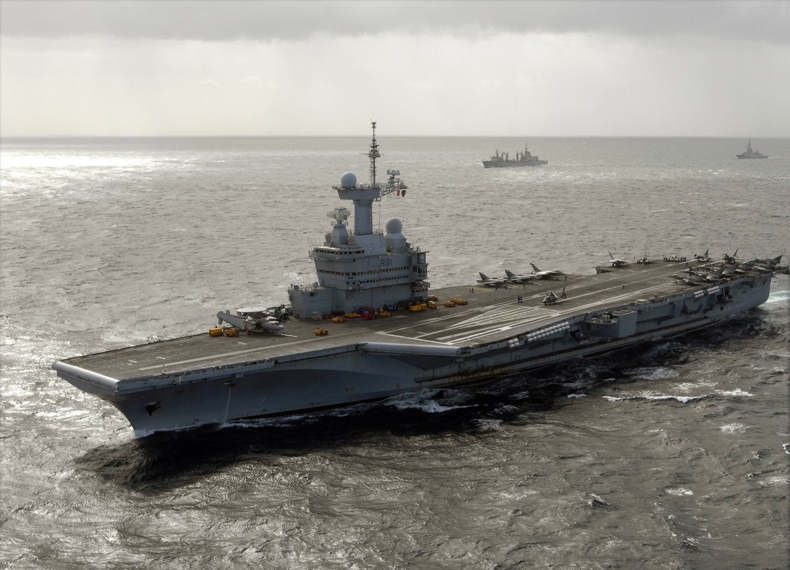
It's happening guys, on the news just now the assassination of a leading Iranian scientist, commonly attributed to Mossad, and therefore Israel/USA. You would have to have eyes wide shut to miss the signs where: the USA is running wars on the following fronts at least:
I don't know how much longer this will string out before the globalists move on Iran.
How to Start a War: The American Use of War Pretext Incidents.
|
The following article by Richard Sanders published in May 2002, prior to the onslaught of the Iraq war, carefully documents the History of War Pretext Incidents.
This historical review raises an important issue: Is the Pentagon seeking to trigger military confrontation in the Persian Gulf with a view to providing a pretext and a justification to waging an all out war on the Islamic Republic of Iran?
As documented by Richard Sanders, this strategy has been used throughout American military history.With regard to the confrontation in the Persian Gulf, is the Obama administration prepared to sacrifice the Fifth Fleet based in Bahrain with a view to triggering public support for a war on Iran on the grounds of self-defense.
Those opposed to war must address the issue of the "pretext"and "justification" to wage war.
Of relevance, the "Responsibility to Protect under a NATO "humanitarian" mandate has also been used as a thematic pretext to wage war (Yugoslavia, Libya, Syria),
The 911 Attacks and the "Global War on Terrorism" (Afghanistan, Somalia, Pakistan,...) not to mention the alleged "Weapons of Mass Destruction" (Iraq) have also been used to justify military intervention. Both 9/11 and WMD are being heralded as a justification for waging war on Iran, based on allegation that Iran was behind the 9/11 attacks and that Iran possesses nuclear weapons.
In the words of Richard Sanders [2002]:
"It is vitally important to expose this latest attempt [9/11] to fraudulently conceal the largely economic and geostrategic purposes of war. By asking who benefits from war, we can unmask its pretense and expose the true grounds for instigating it. By throwing light on repeated historical patterns of deception, we can promote skepticism about the government and media yarns that have been spun to encourage this war.
The historical knowledge of how war planners have tricked people into supporting past wars, is like a vaccine. We can use this understanding of history to inoculate the public with healthy doses of distrust for official war pretext narratives and other deceptive stratagems. Through such immunization programs we may help to counter our society’s susceptibility to “war fever.” "
Michel Chossudovsky, Global Research, January 9, 2012
“Oh what a tangled web we weave, When first we practice to deceive!” Sir Walter Scott, Marmion. Canto vi. Stanza 17
Pretext n. [Latin praetextum, pp. of praetextere, to weave before, pretend, disguise; prae-, before + texere, to weave], a false reason or motive put forth to hide the real one; excuse.
Stratagem [Gr. Strategema, device or act of a general; stratos, army + agein, to lead], a trick, scheme or device used for deceiving an enemy in war.
Throughout history, war planners have used various forms of deception to trick their enemies. Because public support is so crucial to the process of initiating and waging war, the home population is also subject to deceitful stratagems. The creation of false excuses to justify going to war is a major first step in constructing public support for such deadly ventures. Perhaps the most common pretext for war is an apparently unprovoked enemy attack. Such attacks, however, are often fabricated, incited or deliberately allowed to occur. They are then exploited to arouse widespread public sympathy for the victims, demonize the attackers and build mass support for military “retaliation.”
Like schoolyard bullies who shout ‘He hit me first!’, war planners know that it is irrelevant whether the opponent really did ‘throw the first punch.’ As long as it can be made to appear that the attack was unprovoked, the bully receives license to ‘respond’ with force. Bullies and war planners are experts at taunting, teasing and threatening their opponents. If the enemy cannot be goaded into ‘firing the first shot,’ it is easy enough to lie about what happened. Sometimes, that is sufficient to rationalize a schoolyard beating or a genocidal war.
Such trickery has probably been employed by every military power throughout history. During the Roman empire, the causes of war -- cassus belli -- were often invented to conceal the real reasons for war. Over the millennia, although weapons and battle strategies have changed greatly, the deceitful strategem of using pretext incidents to ignite war has remained remarkably consistent.
Pretext incidents, in themselves, are not sufficient to spark wars. Rumors and allegations about the tragic events must first spread throughout the target population. Constant repetition of the official version of what happened, spawns dramatic narratives that are lodged into public consciousness. The stories become accepted without question and legends are fostered. The corporate media is central to the success of such ‘psychological operations.’ Politicians rally people around the flag, lending their special oratory skills to the call for a military “response.” Demands for “retaliation” then ring out across the land, war hysteria mounts and, finally, a war is born.
Every time the US has gone to war, pretext incidents have been used. Upon later examination, the conventional perception of these events is always challenged and eventually exposed as untrue. Historians, investigative journalists and many others, have cited eyewitness accounts, declassified documents and statements made by the perpetrators themselves to demonstrate that the provocative incidents were used as stratagems to stage-manage the march to war.
Here are a few particularly blatant examples of this phenomenon.
1846: The Mexican-American War
CONTEXT After Mexico’s revolution in 1821, Americans demanded about $3,000,000 in compensation for their losses.1 Mexico abolished slavery in 1829 and then prohibited further U.S. immigration into Texas, a Mexican state. In 1835, Mexico tried to enforce its authority over Texas. Texans, rallying under the slogan "Remember the Alamo!”, drove Mexican troops out of Texas and proclaimed independence. For nine years, many Texans lobbied for US annexation. This was delayed by northerners who opposed adding more slave territories to the US and feared a war with Mexico.2
In 1844, Democratic presidential candidate, James Polk, declared support for annexing Texas and won with the thinnest margin ever.3 The following year, Texas was annexed and Mexico broke off diplomatic relations with the US. Polk sent John Slidell to Mexico offering $25 million for New Mexico, California and an agreement accepting the Rio Grande boundary. Mexican government officials refused to meet the envoy.4
PRETEXT John Stockwell, a Texan who led the CIA’s covert 1970s war in Angola, summed up the start of Mexican American war by saying “they offered two dollars-a-head to every soldier who would enlist. They didn't get enough takers, so they offered a hundred acres to anyone who would be a veteran of that war. They still didn't get enough takers, so [General] Zachary Taylor was sent down to parade up and down the border -- the disputed border -- until the Mexicans fired on him.... And the nation rose up, and we fought the war.”5
President Polk hoped that sending General Taylor’s 3,500 soldiers into Mexico territory, would provoke an attack against US troops.6 “On May 8, 1846, Polk met with his Cabinet at the White House and told them that if the Mexican army attacked the U.S. forces, he was going to send a message to Congress asking for a declaration of war. It was decided that war should be declared in three days even if there was no attack.”7
When news of the skirmish arrived, Polk sent a message to Congress on May 11: “Mexico has passed the boundary of the U.S. and shed American blood on American soil.”8 Two days later Congress declared war on Mexico.9
RESPONSE Newspapers helped the push for war with headlines like: “‘Mexicans Killing our Boys in Texas.’10
With public support secured, U.S. forces occupied New Mexico and California. US troops fought battles across Mexico and stormed their capital. A new more US-friendly government quickly emerged. It signed over California and New Mexico for $15 million and recognized the Rio Grande as their border with the US state of Texas.11
General Taylor became an American war hero and he rode his victory straight into the White House by succeeding Polk as president in 1849.
REAL REASONS The US secured over 500,000 square miles from Mexico, including Texas, Nevada, New Mexico, Arizona, California and parts of Colorado and Wyoming.
The war was a boon to US nationalism, it boosted popular support for a very weak president and added vast new territories to the US where slavery was allowed.
1898: The Spanish-American War
CONTEXT Cubans fought several wars to free themselves from Spanish colonial rule, including 1868-1878, 1879-1880 and 1895-1898.12 In 1898, Cubans were on the brink of finally winning their independence. The US government agreed to respect Cuba’s sovereignty and promised they would not step in.
"On January 24, [1898] on the pretext of protecting the life and safety of Mr. Lee, U.S. consul in Havana, and other U.S. citizens in the face of street disturbances provoked by Spanish extremists, the Maine battleship entered the bay of Havana.”13
PRETEXT On February 15, 1898, a huge explosion sank the USS Maine killing 266 of its crew.14
In 1975, an investigation led by US Admiral Hyman Rickover concluded that there was no evidence of any external explosion. The explosion was internal, probably caused by a coal dust explosion. Oddly, the ship's weapons and explosives were stored next to the coal bunker.15
RESPONSE The Maine’s commander cautioned against assumptions of an enemy attack. The press denounced him for "refusing to see the obvious." The Atlantic Monthly said anyone thinking this was not a premeditated, Spanish act of war was "completely at defiance of the laws of probability."16
Newspapers ran wild headlines like: “Spanish Cannibalism,” “Inhuman Torture,” “Amazon Warriors Fight For Rebels.”17 Guillermo Jimpnez Soler notes: “As would become its usual practice, U.S. intervention in the war was preceded by intensive press campaigns which incited jingoism, pandering to the most shameless tales and sensationalism and exacerbated cheap sentimentality. Joseph Pulitzer of The World and William Randolph Hearst from The Journal, the two largest U.S. papers... carried their rivalry to a paroxysm of inflaming public opinion with scandalous, provocative and imaginary stories designed to win acceptance of U.S. participation in the first of its holy wars beyond its maritime borders.”18
US papers sent hundreds of reporters and photographers to cover the apparent Spanish attacks. Upon arrival, many were disappointed. Frederick Remington wrote to Hearst saying: “There is no war .... Request to be recalled.” Hearst’s now-famous cable replied: "Please remain. You furnish the pictures, I'll furnish the war." For weeks, The Journal dedicated more than eight pages per day to the explosion.19
Through ceaseless repetition, a rallying cry for retaliation grew into a roar. “In the papers, on the streets and in…Congress. The slogan was "Remember the Maine! To hell with Spain."20
With the US public and government safely onboard, the US set sail for war launching an era of ‘gunboat diplomacy.’ Anti-war sentiments were drowned out by the sea of cries for war. On April 25, 1898, the US Congress declared war on Spain.
REAL REASONS Within four months “the US replaced Spain as the colonial power in the Philippines, Guam and Puerto Rico, and devised a special status for Cuba. Never again would the US achieve so much…as in that ‘splendid little war,’ as…described at the time by John Hay, future secretary of state.”21
Historian Howard Zinn has said that 1898 heralded “the most dramatic entrance onto the world scene of American military and economic power.… The war ushered in what Henry Luce later referred to as the American Century, which really meant a century of American domination.”22
1915: World War I
CONTEXT In 1915, Europe was embroiled in war, but US public sentiment opposed involvement. President Woodrow Wilson said they would “remain neutral in fact as well as in name.”23
PRETEXT On May 7, 1915, a German submarine (U-boat) sank the Lusitania, a British passenger ship killing 1,198, including 128 Americans.24
The public was not told that passengers were, in effect, a ‘human shield’ protecting six million rounds of US ammunition bound for Britain.25 To Germany, the ship was a threat. To Britain, it was bait for luring an attack. Why?
British Admiralty leader, Winston Churchill, had already commissioned “a study to determine the political impact if an ocean liner were sunk with Americans on board.”26 A week before the incident, Churchill wrote to the Board of Trade’s president saying it is “most important to attract neutral shipping to our shores, in the hopes especially of embroiling the U.S. with Germany.”27
British Naval Intelligence Commander, Joseph Kenworthy, said: “The Lusitania was sent at considerably reduced speed into an area where a U-boat was known to be waiting and with her escorts withdrawn.”28
Patrick Beesly’s history of British naval intelligence in WWI, notes: "no effective steps were taken to protect the Lusitania.” British complicity is furthered by their foreknowledge that: · U-boat commanders knew of the Lusitania’s route, · a U-boat that had sunk two ships in recent days was in the path of the Lusitania, · although destroyers were available, none escorted the Lusitania or hunted for U-boats, · the Lusitania was not given specific warnings of these threats.29
RESPONSE US newspapers aroused outrage against Germany for ruthlessly killing defenceless Americans. The US was being drawn into the war. In June 1916, Congress increased the size of the army. In September, Congress allocated $7 billion for national defense, “the largest sum appropriated to that time.”30
In January 1917, the British said they had intercepted a German message to Mexico seeking an alliance with the US and offering to help Mexico recover land ceded to the US. On April 2, Wilson told Congress: “The world must be safe for democracy.” Four days later the US declared war on Germany.31
REAL REASONS Influential British military, political and business interests wanted US help in their war with Germany. Beesly concludes that “there was a conspiracy deliberately to put the Lusitania at risk in the hope that even an abortive attack on her would bring the U.S. into the war.”32
Churchill’s memoirs of WWI state: "There are many kinds of maneuvres in war, some only of which take place on the battlefield.... The maneuvre which brings an ally into the field is as serviceable as that which wins a great battle."33
In WWI, rival imperialist powers struggled for bigger portions of the colonial pie. “They were fighting over boundaries, colonies, spheres of influence; they were competing for Alsace-Lorraine, the Balkans, Africa and the Middle East.”34 US war planners wanted a piece of the action.
"War is the health of the state," said Randolph Bourne during WWI. Zinn explains: “Governments flourished, patriotism bloomed, class struggle was stilled.”35
1941: World War II
CONTEXT US fascists opposed President Franklin D. Roosevelt (FDR) from the start. In 1933, “America's richest businessmen were in a panic. Roosevelt intended to conduct a massive redistribution of wealth…[and it] had to be stopped at all costs. The answer was a military coup…secretly financed and organized by leading officers of the Morgan and du Pont empires.”36
A top Wall Street conspirator said: "We need a fascist government in this country…to save the nation from the communists who want to tear it down and wreck all that we have built.”37
The Committee on Un-American Activities said: “Sworn testimony showed that the plotters represented notable families -- Rockefeller, Mellon, Pew, Pitcairn, Hutton and great enterprises -- Morgan, Dupont, Remington, Anaconda, Bethlehem, Goodyear, GMC, Swift, Sun.”38
FDR also faced “isolationist” sentiments from such millionaires who shared Hitler’s hatred of communism and had financed Hitler’s rise to power as George Herbert Walker and Prescott Bush, predecessors of the current president.39 William R.Hearst, mid-wife of the war with Spain, opposed a war against fascism. Hearst employed Hitler, Mussolini and Goering as writers. He met Hitler in 1934 and used Readers’ Digest and his 33 newspapers to support fascism.40
PRETEXT On December 7, 1941, Japanese bombers attacked the US Pacific Fleet in Pearl Harbour, Hawaii, killing about 2,460.41
FDR, and his closest advisors, not only knew of the attack in advance and did not prevent it, they had actually provoked it. Lt. Arthur McCollum, head of the Far East desk for U.S. Navy intelligence, wrote a detailed eight-step plan on October 7, 1940 that was designed to provoke an attack.42 FDR immediately set the covert plan in motion. Soon after implementing the final step, Japan attacked Pearl Harbour.
After meeting FDR on October 16, 1941, Secretary of War Henry Stimson wrote: "We face the delicate question of the diplomatic fencing to be done so as to be sure Japan is put into the wrong and makes the first bad move -- overt move.” On November 25, after another meeting with FDR, Stimson wrote: "The question was: how we should maneuver them [the Japanese] into the position of firing the first shot.”43
The next day, an insulting “ultimatum” was delivered to the Japanese. The US intercepted a coded Japanese cable calling the ultimatum a “humiliating proposal” and saying they would now prepare for war with the US.44
The US had cracked Japanese diplomatic and military codes.45 A Top Secret Army Board report (October 1944), shows that the US military knew “the probable exact hour and date of the attack.”46 On November 29, 1941, the Secretary of State revealed to a reporter that the attack’s time and place was known. This foreknowledge was reported in the New York Times (Dec. 8, 1941).47
RESPONSE After Pearl Harbour, the US quickly declared war against Japan. With media support, “Remember Pearl Harbour!” became an American rallying cry. On December 11, Germany and Italy declared war on the US.
As the war wound down, decoded messages revelaed to the US military that Japan would soon surrender. They knew the atomic destruction of Hiroshima and Nagasaki was unnecessary. Although nuclear weapons are commonly believed to have ended WWII, they were an opening salvo in the Cold War against the USSR.
REAL REASONS The US used WWII to maneuver itself into a position of superiority over former imperial rivals in Europe. In Parenti’s words the US “became the prime purveyor and guardian of global capitalism.”48 As the only nation wielding nuclear weapons, the US also became the world’s sole superpower.
1950: The Korean War
CONTEXT There is “extensive evidence of U.S. crimes against peace and crimes against humanity” KWCT committed after they occupied southern Korea in September 1945. The US worked to “create a police state…using many former collaborators with Japanese rule, provoke tension…between southern and northern Korea, opposing and disrupting any plans for peaceful reunification. The U.S. trained, directed and supported ROK [South Korea] in systematic murder, imprisonment, torture, surveillance, harassment and violations of human rights of hundreds of thousands…, especially…nationalists, leftists, peasants seeking land reform, union organizers and/or those sympathetic to the north.”49
University of Hawaii professor, Oliver Lee, notes a “long pattern of South Korean incursions” into the north. In 1949, there were more than 400 border engagements. A US Army document states: “Some of the bloodiest engagements were caused by South Korean units securing and preparing defensive positions that were either astride or north of the 38th parallel. This provoked violent North Korean actions.”50
PRETEXT On June 25, 1950, the North Korean military were said to have moved three miles into South Korea territory.
Dr. Channing Liem, the former South Korean ambassador to the UN (1960-1961) wrote: “For Washington, the question, ‘who fired the first shot?’ carried special significance…. Assistant Secretary of State for UN Affairs…[revealed] before the Senate Appropriations Committee, 1950, the US had devised a plan prior to the start of the war to gain approval from the UN to send its troops to Korea under the UN flag in the event that South Korea was attacked. It was imperative, therefore, that the ‘first shot’ be fired by the North, or at least that such an argument could be made.”51
ROK President Syngman Rhee triggered the war “with behind the scene support of John Foster Dulles,” the former-U.S. Secretary of State who met Rhee (June 18, 1950) just days before the pretext incident. Dulles told Rhee that “if he was ready to attack the communist North, the U.S. would lend help, through the UN…. He advised Rhee…to persuade the world that the ROK was attacked first, and to plan his actions accordingly.”52
Albert Einstein told Liem in 1955 that “the US was manipulating the UN…. [It] was being exploited by the great powers at the expense of the small nations…. He went on to say great powers do not act on the basis of facts only but manufacture the facts to serve their purposes and force their will on smaller nations.”53
I.F.Stone was perhaps the first to expose how a US diplomat deceived the UN Secretary General into believing there had been an unprovoked North Korean attack.54
North Korea claimed the attack began two days earlier when ROK divisions launched a six-hour artillery attack and then pushed 1 or 2 kilometers across the border. They responded to “halt the enemy's advance and go over to a decisive counterattack.”55
RESPONSE Secretary of State, Dean Acheson was “quick to seize the opportunity to blame the war on North Korea regardless of the evidence.” North Korea was accused of “brutal, unprovoked aggression.”56
The public was told that this ‘invasion’ was the first step in Soviet plans for world domination. Anyone opposing the war was called a communist. McCarthyism was on.
On June 27, 1950, Truman orders US troops to support South Korea, Congress agrees and the UN Security Council approves the plan.57
About three million civilians were killed, two-thirds in North Korea.58
REAL REASONS To maintain power, South Korea required major US military support. One month before the pretext, Rhee suffered a terrible electoral defeat. Opposing North Korea, diverted public attention from Rhee’s repression to the communist north.
The war was used to triple the Pentagon budget, boost NATO’s military build-up and create a new military role for the UN that could be manipulated by the US.
1964: The Vietnam War
CONTEXT Long before WWII, Vietnamese fought for independence from French Indochina. Resistance continued when Japanese troops occupied the colony during the war. Much of the region reverted to French control after the war. As early as 1950, the US aided French efforts to defeat the Ho Chi Minh’s revolutionary forces. When France lost a decisive battle in 1954, the Geneva Accord recognized the independence of Vietnam, Laos and Cambodia. Vietnam was “temporarily” divided. Ngo Dinh Diem’s repressive regime in South Vietnam was backed by thousands of US military “advisors.” A military coup overthrew Diem in November 1963.59
That same month, President Kennedy -- who had resisted escalating the war -- was assassinated. President Johnson took power and began intensified US involvement in Vietnam.
PRETEXT On July 30, 1964, enemy torpedo boats supposedly attacked a US destroyer, the USS Maddox, in North Vietnam’s Gulf of Tonkin. This lie of an “unprovoked attack” against a “routine patrol” threw the U.S. headlong into war.
The Maddox was actually involved in “aggressive intelligence gathering in coordination with actual attacks by South Vietnam and the Laotian Air Force against targets in North Vietnam.”60 They wanted to provoke a response “but the North Vietnamese wouldn't bite. So, Johnson invented the attack.”61
The US task force commander for the Gulf of Tonkin “cabled Washington that the report was the result of an ‘over-eager’ sonarman who picked up the sounds of his own ship's screws and panicked.”62
RESPONSE On August 5, 1964, although he knew the attack had not occurred, Johnson couldn’t resist this opportunity for a full-scale war.
Johnson went on national TV to lie about the Tonkin incident and to announce a bombing campaign to “retaliate.” The media repeated the lie ad nauseum. The fabricated assault was “used as justification for goading Congress into granting the president the authorization to initiate a protracted and highly lucrative war with North Vietnam.”63 Johnson asked Congress for powers “to take all necessary measures to repel any armed attack against the forces of the US and to prevent further aggression.”64
Before the war ended in 1975, about four million in Southeast Asia were killed.
REAL REASONS As during the Spanish-American war, the American business elite sought to acquire colonies from failing imperial powers.
President Dwight Eisenhower propounded the ‘Domino Theory’ in 1954.65 If South Vietnam ‘fell,’ then other countries would too, ‘like a set of dominos.’ The Vietnam War was a threat to all revolutionaries and their supporters.
The war also gave a huge boost to US war industries. Other US corporations wanted access to region’s markets and resources, like tin, tungsten, rubber.66
1983: The Invasion of Grenada
CONTEXT For decades, Eric Gairy dominated the tiny British colony of Grenada. Gairy “a vicious dictator…[was] the only Caribbean leader to maintain diplomatic relations with Pinochet’s Chile.” When his “notorious security forces” returned from training in Chile “‘disappearances’ became frequent.”67 ‘Gariyism’ was so bad that when Britain offered independence, Grenadans united to “shut down the country…prior to Independence Day, February 7, 1974."68
The New Jewel Movement (NJM) led a successful uprising on March 13, 1979. The NJM “organized agrarian reform…, expanded trade union rights, advanced women's equality…, established literacy programs and instituted free medical care.”69
The CIA "relentlessly used every trick in its dirty bag” including "an unending campaign of economic, psychological and openly violent destabilization." Reagan met Caribbean leaders, the US urged "regional governments to consider military action" and CIA chief, William Casey, met Senate Intelligence Committee members "to discuss CIA involvement." Gairy began “recruiting mercenaries from…the Cuban exile community in Miami.”70 (ER BS p.3-5)
In October1981, a US military exercise simulated an invasion of Grenada ostensibly to rescue Americans and "install a regime favorable to the way of life we espouse."71
In March 1983, Reagan exclaimed on TV that Grenada’s tourist airport threatened US oil supply routes.72
On October 19, 1983, NJM leader Maurice Bishop, and others, were put under house arrest during an coup by NJM’s Deputy PM Bernard Coard. Oddly, they were freed by a "well organized crowd…including counter-revolutionary elements…with anti-communist banners…. [led by] well known businessmen…. Who organized this rally, planned so well, and in advance?" Freed NJM leaders were whisked away and as a “crowd gathered…the soldiers, apparently panicked by explosions, opened fire.… something provoked them, leading to a massacre." NJM leaders surrendered to soldiers and were soon executed.73
Significantly, "Pentagon officials informed Members of Congress that they had known of the impending coup…two weeks in advance."74
The coup plotters were charged with the murders but their lawyer, former US Attorney General Ramsey Clarke believe them innocent of the murders.75 It seems the coup was hijacked by US interests to kill some NJM leaders, jail the rest and set the stage for an invasion.
PRETEXT In his Naval Science course, Captain M.T.Carson lists the invasion’s "stated reasons" as "protect Americans, eliminate hostage potential; restore order; requested by OECS [Organization of Eastern Caribbean States]."76
The US helped form the OECS, and then got it and the Grenadan governor to "request" an invasion. Under “potential problem,” Carson notes "Act fast with surprise and present world with fait accompli. If not, world opinion of U.S. invasion of tiny country will be critical. So: · “Get OECS to request action.” · “Get Governor Scoon to request action.” · “Emphasize students-in-danger aspect"77
Carson quotes a "medical school official": "Our safety was never in danger. We were used as an excuse by this government to invade…. They needed a reason…and we were it." MTC Most students "insisted” that they were “not…in any danger before the US invasion; only afterwards."78
RESPONSE On October 22, 1983, "Operation Urgent Fury" was ordered.79 Three days later, the invasion hit like a cyclone.
The Organization of American States "deeply deplored" the invasion and the UN Security Council voted 11 to 1 against it.80
REAL REASONS Grenada threatened the US by providing a powerful example of viable alternative ways to organize social, political and economic structures.
Carson lists these reasons: · "Chance to eliminate Communist regime and replace with pro-U.S. government” · “Demonstrate U.S. military capabilities” · “President Reagan commented that U.S. military forces were back on their feet and standing tall."81
US military morale was damaged two days before the invasion when 241 Marines were killed in Lebanon.82
The Wall Street Journal said the invasion made Grenada a "haven for offshore banks."83
1989: The Invasion of Panama
CONTEXT The Panama Canal has dominated Panama’s history. US military invasions and interventions occurred in 1895, 1901-1903, 1908, 1912, 1918-1920, 1925, 1950, 1958, 1964 and 1989.84
In November 1903, US troops ensured Panama’s secession from Colombia. Within days, a treaty gave the US permanent and exclusive control of the canal.85
Former Panamanian military leader, Manuel Noriega, recruited by US military intelligence in 1959, attended the US Army School of the Americas in 1967 and led Panama’s military intelligence the next year. By 1975, the US Drug Enforcement Agency knew of Noriega’s drug dealing. He met, then-CIA Director, George Bush in 1976.86
In 1977, Presidents Jimmy Carter and Omar Torrijos, signed a treaty to return the canal to Panamanian control in 1999. Other Americans undermined the treaty using “diplomatic…and political pressure, through to economic aggression and military invasion.”87
In the early-1980s, Noriega’s drug smuggling helped fund the contras in Nicaragua. He took control of Panama’s National Guard in 1983 and helped rig elections in 1984. Falling from US favour, the US indicted Noriega for drug crimes in 1988.88
On April 14, 1988, Reagan invoked “war powers” against Panama. In May, the Assistant Defense Secretary told the Senate: “I don’t think anyone has totally discarded the use of force.”89
PRETEXT On December 16, 1989, there was what media called an “unprovoked attack on a US soldier who did not return fire.”90 The soldier was killed when driving “through a military roadblock near a sensitive military area.”91 Panama’s government said “U.S. officers…fired at a military headquarters, wounding a soldier and…a 1-year-old girl. A wounded Panamanian soldier…confirmed this account to U.S. reporters.”92 The wife of a US officer was reportedly arrested and beaten.
RESPONSE George Bush called the attack on US soldiers an “enormous outrage”93 and said he “would not stand by while American womanhood is threatened.”94 Noam Chomsky questions why Bush “stood by” when a US nun was kidnapped and sexually abused by Guatemalan police only weeks earlier, when two US nuns were killed by contras in Nicaragua on January 1, 1990, and when a US nun was wounded by gunmen in El Salvador around the same time.95
The US media demonized Noriega and turned the “‘Noriega’ issue into an accepted justification for the invasion…. Colonel Eduardo Herrera, ex-Director of [Panama’s] ‘Public Forces,’…said: “If the real interest of the US was to capture Noriega, they could have done so on numerous occasions. [They] had all of his movements completely controlled.”96
On December 20, 1989, “Operation Just Cause” began. More than 4,000 were killed. US crimes included indiscriminate attacks, extra judicial executions, arbitrary detentions, destruction of property (like leveling the Chorrillo neighborhood), use of prohibited weapons, erasing evidence and mass burials.97
A US-friendly president, Guillermo Endara, was soon sworn in on a US military base.
REAL REASONS The Carter-Torrijos Treaty was torn up and the Panama’s military was dismantled.
A right-wing, US think tank stated in 1988 that: “once [Panama] is controlled by a democratic regime….discussions should begin with respect to a realistic defense of the Canal after…2000. These discussions should include the maintenance, by the US, of a limited number of military installations in Panama…to maintain adequate projection of force in the western hemisphere.”98
The invasion was a testing ground for new weapons, such as the B-2 bomber (worth US $2.2 billion) that was used for the first time.
The invasion also: · rectified “Bush's ‘wimpy’ foreign relations image” · gave a “spectacular show of U.S. military might in the final months before the Nicaraguan elections, hinting…that they might want to vote for the ‘right’ candidate.” · “sent a signal…that the US…[would] intervene militarily where the control of illegal drugs was ostensibly at stake. · “demonstrated the new U.S. willingness to assume active, interventionist leadership of the ‘new world order’ in the post-Cold War period.”99
CONCLUSIONS
There are dozens of other examples from US history besides those summarized here. The “Cold War” was characterized by dozens of covert and overt wars throughout the Third World. Although each had its specific pretexts, the eradication of communism was the generally-used backdrop for all rationales.100
Since the Soviet Union’s demise, US war planners have continued to use spectacular pretext incidents to spawn wars. Examples include Iraq (1991), Somalia (1992), Haiti (1994), Bosnia (1995) and Yugoslavia (1999).
Throughout this time, the US “War on Drugs” has been fought on many fronts. Lurking behind the excuse to squash illicit drug trafficking, are the actual reasons for financing, training and arming right-wing, US-backed regimes, whose officials have so often profited from this illegal trade. The CIA has used this trade to finance many of its covert wars.101 The “War on Drugs” has targeted numerous countries to strengthen counter-insurgency operations aimed at destroying opposition groups that oppose US corporate rule.
Military plotters know that the majority would never support their wars, if it were generally known why they were really being fought. Over the millennia, a special martial art has been deliberately developed to weave elaborate webs of deceit to create the appearance that wars are fought for “just” or “humanitarian” reasons.
If asked to support a war so a small, wealthy elite could shamelessly profit by ruthlessly exploiting and plundering the natural and human resources in far away lands, people would ‘just say no.’
We now face another broad thematic pretext for war, the so-called “War Against Terrorism.” We are told it will be waged in many countries and may continue for generations. It is vitally important to expose this latest attempt to fraudulently conceal the largely economic and geostrategic purposes of war. By asking who benefits from war, we can unmask its pretense and expose the true grounds for instigating it. By throwing light on repeated historical patterns of deception, we can promote skepticism about the government and media yarns that have been spun to encourage this war.
The historical knowledge of how war planners have tricked people into supporting past wars, is like a vaccine. We can use this understanding of history to inoculate the public with healthy doses of distrust for official war pretext narratives and other deceptive stratagems. Through such immunization programs we may help to counter our society’s susceptibility to “war fever.”
Notes
1. “History of Mexico, Empire and Early Republic, 1821-55,” Area Handbook, US Library of Congress.
2. Shayne M. Cokerdem, “Unit Plan: Manifest Destiny and The Road to the Civil War.”
3. P.B.Kunhardt, Jr., P.B.Kunhardt III, P.W.Kunhardt, “James Polk,” The American President, 2000.
4. “Diplomatic Approaches: U.S. Relations with Mexico: 1844-1846,” LearnCalifornia.org, 2000.
5. John Stockwell, “The CIA and the Gulf War,” Speech, Santa Cruz, CA, Feb.20, 1991, aired by John DiNardo, Pacifica Radio.
6. Betsy Powers, “The U.S.-Mexican War of 1846-48,” War, Reconstruction and Recovery in Brazoria County.
7. “The White House and Western Expansion,” Learning Center, White House Historical Association.
8. Powers
9. White House Historical Association
10. Stockwell
11. P.B.Kunhardt, Jr., P.B.Kunhardt III, P.W.Kunhardt
12. Ed Elizondo, “History of the Cuban Liberation Wars,” Oct.2, 2001.
13. Guillermo Jimpnez Soler, "The emergence of the United States as a world power", Granma International, Aug.7, 1998.
14. Bill Sardi, “Remember the Maine! And the Other Ships Sunk to Start a War” Oct.16, 2000.
15. Michael Rivero, “Dictatorship through Deception,” New Republic Forum, Dec.24, 1999.
16. Rivero
17. J. Buschini, “The Spanish-American War,” Small Planet Communications, 2000.
18. Soler
19. Buschini
20. Buschini
21. Soler
22. Howard Zinn, “History as a Political Act,” Revolutionary Worker, December 20, 1998.
23. Woodrow Wilson, Message to Congress, Aug. 19, 1914, Senate Doc.#566, pp.3-4, World War I Document Archive.
24. Greg D.Feldmeth, “The First World War,” U.S. History Resources, Mar.31, 1998.
25. James Perloff, “Pearl Harbor,” The New American, Vol. 2, No. 30, December 8, 1986.
26. James Perloff
27. Winston Churchill, cited by Ralph Raico, “Rethinking Churchill,” The Costs of War: America's Pyrrhic Victories, 1997.
28. Harry V.Jaffa, “The Sinking of the Lusitania: Brutality, Bungling or Betrayal?” The Churchill Center.
29. Patrick Beesly, Room 40: British Naval Intelligence, 1914-18, 1982 cited by RR
30. Peter Young, “World War I,” World Book Encyclopedia, 1967, pp. 374-375.
31. Wendy Mercurio, “WWI Notes, From Neutrality to War,” Jan.2002.
32. Patrick Beesly, cited by Ralph Raico
33. Winston Churchill, cited by Ralph Raico
34. Howard Zinn, “War Is the Health of the State,” A People's History of the United States, 1492-Present, Sept. 2001.
35. Zinn
36. Steve Kangas, “The Business Plot to Overthrow Roosevelt,” Liberalism Resurgent: A Response to the Right, 1996.
37. Gerald MacGuire, cited by Steve Kangas
38. Dale Wharton, Book review of The Plot to Seize the White House (1973) by Jules Archer, Eclectica Book Reviews.
39. Webster G.Tarpley and Anton Chaitkin, “The Hitler Project,” George Bush: The Unauthorized Biography, 1992.
40. David Nasaw, “Remembering ‘The Chief,’" interview, Newshour, Sept.7, 2000.
41. Joseph Czarnecki, Richard Worth, Matthias C. Noch and Tony DiGiulian, “Attack on Pearl Harbor, 7 December 1941,” The Battles Of The Pacific.
42. Steve Fry, “Author: FDR knew attack was coming,” The Capital-Journal, June 12, 2001.
43. Henry Stimson, cited by Robert Stinnett, Day of Deceit: The Truth about FDR and Pearl Harbour, 2000.
44. Percy L.Greaves, Jr., “What We Knew,” Institute for Historical Review, Winter, 1983, p.467.
45. “The MAGIC Documents: Summaries and Transcripts of the Top-Secret Diplomatic Communications of Japan, 1938-1945,” GB 0099 KCLMA MF 388-401.
46. Paul Proteus, “Part One: Pearl Harbour,” America's Phoney Wars.
47. Rivero
48. Michael Parenti, Against Empire, 1995, p.36.
49. “Final Judgement of the Korea International War Crimes Tribunal,” June 23, 2001.
50. Oliver Lee, "South Korea Likely Provoked War with North," Star-Bulletin, June 24, 1994.
51. Channing Liem, The Korean War (6.25, 1950 - 7.27, 1953) - An Unanswered Question, 1993.
52. Liem
53. Albert Einstein cited by Channing Liem.
54. I.F.Stone, Hidden History of the Korean War, 1952, cited by Channing Liem.
55. Liem
56. Lee
57. Jim Caldwell, “Korea - 50 years ago this week, June 25-28, 1950,” ArmyLINK News, June 20, 2000.
58. Jon Halliday and Bruce Cumings, Korea: The Unknown War, 1988, p.200, cited by Robin Miller, “Washington's Own Love Affair with Terror”
59. Sandra M.Wittman, “Chronology of US-Vietnamese Relations,” Vietnam: Yesterday and Today.
60. Rivero
61. John DiNardo, “The CIA and the Gulf War,” aired by Pacifica Radio.
62. Rivero
63. DiNardo
64. Joint Resolution, U.S. Congress, Aug.7, 1964, “The Tonkin Bay Resolution, 1964,” Modern History Sourcebook, July 1998.
65. Dwight D. Eisenhower, “Domino Theory Principle, 1954,” Public Papers of the Presidents, Dwight D. Eisenhower, 1954, pp.381-390. (News Conference, April 7, 1954.)
66. Eisenhower
67. Ellen Ray and Bill Schaap, “US Crushes Caribbean Jewel.” Covert Action Information Bulletin (CAIB), winter 1984, p.8
68. Jeff Hackett, “Burying ‘Gairyism.’” Bibliographies
69. Preface to Maurice Bishop speech “In Nobody's Backyard,” April 13, 1979, The Militant, Mar.15 1999.
70. Ray and Schaap, pp.3-5
71. Ray and Schaap, p.6
72. Clarence Lusane, “Grenada, Airport ’83: Reagan’s Big Lie,” CAIB, Spring-Summer 1983, p.29.
73. Ray and Schaap, pp.10-11
74. Ray and Schaap, p.5
75. Alan Scott, "The Last Prisoners of the Cold War Are Black," letter, The Voice (Grenada), April 20, 2001.
76. Capt. M.T.Carson, USMC, (Marine Officer Instructor), “Grenada October 1983,” History of Amphibious Warfare (Naval Science 293), Naval Reserves Officer Training Corps, University of Illinois at Urbana Champaign.
77. Carson
78. Ray and Schaap, p..8.
79. Carson
80. “Failures of U.S. Foreign Policy,” Alternativeinsight, Sept.1, 2001
81. Carson
82. Alternativeinsight, Sept.1, 2001
83. Anthony Arnove and Alan Maass, “Washington’s war crimes,” Socialist Worker, Nov.16, 2001.
84. Zoltan Grossman, “One Hundred Years of Intervention,” 2001.
85. Commission for the Defence of Human Rights in Latin America (CODEHUCA), This is the Just Cause, 1990, p.115.
86. Richard Sanders, “Manuel Noriega,” Press for Conversion!, Dec. 2000, p.40.
87. CODEHUCA, pp.117, 108
88. Sanders
89. CODEHUCA, p.108
90. Richard K. Moore, “The Police State Conspiracy an Indictment,” New Dawn Magazine, Jan.-Dec. 1998.
91. Noam Chomsky, “Operation Just Cause: the Pretexts,” Deterring Democracy, 1992.
92. Chomsky
93. Alexander Safian, “Is Israel Using ‘Excessive Force’ Against Palestinians?” Fact sheet: Myth of Excessive Force, Nov.9, 2000
94. Chomsky
95. Chomsky
96. CODEHUCA, p.106.
97. CODEHUCA, passim
98. Fellowship of Reconciliation (FOR), “Panama: A Test for U.S.-Latin American Foreign Relations,” Interhemispheric Resource Center Bulletin, May 1995
99. FOR
100. William Blum, Killing Hope: U.S. Military and CIA Interventions Since World War II, 2000.
101. Alfred McCoy, The Politics of Heroin: CIA Complicity in the Global Drug Trade, 1991.